Mastering Coding Agent Workflows: From Prompt to Production
By Chris Moen • Published 2026-05-01
Explore how coding agents move beyond autocomplete to plan, execute, and iterate on code. This guide covers essential workflow types, practical loops, and production-ready patterns for integrating AI coding agents effectively.
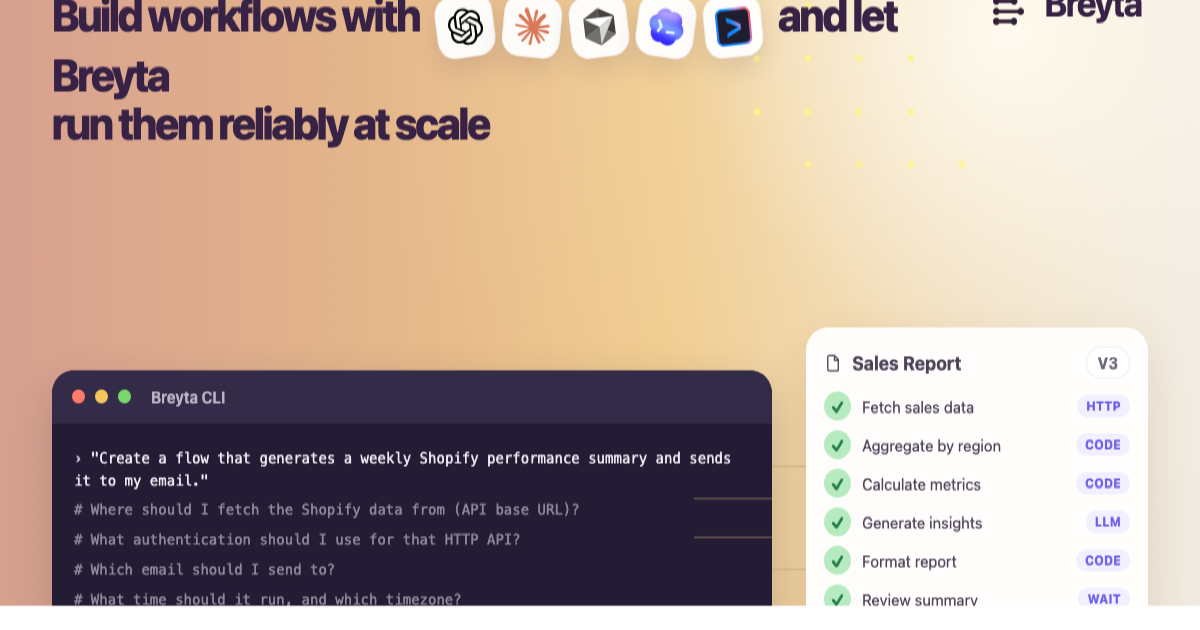
Opening answer Coding agent workflows let an agent take a goal, plan steps, and execute changes across a codebase. They differ from autocomplete and chat because they act. This guide shows how to run them well, and how Breyta supports production use.
What this means in practice
- Agents are not just inline helpers. They plan and perform multi-step work with file edits, tests, and commits. That is the key difference from autocomplete or chat, which stay reactive. See this framing in a practical guide on agent behavior and autonomy from Devtools Academy’s piece on AI coding agents (AI coding agents take a goal, plan, and act) (AI Coding Agents: A Practical Guide).
- Developers still own judgment. Direct the agent. Verify the result. Treat it like a fast junior who needs intent and constraints.
Why it matters for production workflows
- Real work is long running and multi-step. You need a way to pause, resume, and keep state.
- You also need clear run history, versioned releases, and control points like approvals.
- Agent ecosystems are moving this way too. The VS Code team highlights lifecycle hooks, skills, session memory, and handling large outputs to keep long sessions useful and controllable (Making agents practical for real-world development).
Four common workflow types
A helpful map groups agent workflows into four types. Real Python describes IDE, terminal, PR, and cloud agents as the main modes for developers today (AI Coding Agents Guide: Four Workflow Types).
- IDE agents: Work inside the editor. Read and change files. Show diffs. Great for scoped refactors.
- Terminal agents: Run from the CLI. Compose shell tools and scripts. Good for pipelines and local automation.
- PR agents: Propose changes as pull requests. Fit review loops and team standards.
- Cloud agents: Run remotely. Useful for heavy jobs, scheduled tasks, or when you need steady state and callbacks.
A practical loop you can trust
A short, durable loop keeps quality high. It aligns with several grounded field notes on agent use, including step-by-step approaches from Devtools Academy and from Jack Marchant’s 2025 workflow write-up (using coding agents in my workflow).
- Plan: Write intent and constraints. Keep scope small. If the plan is unclear, the agent will guess.
- Code: Delegate discrete tasks. Avoid vague “build the whole feature” prompts.
- Review: Read with suspicion. Check correctness, error handling, security, and architecture.
- Test: Run real tests. Expand coverage. Do not ship on the agent’s optimism alone.
- Iterate: Tighten prompts. Rerun. Improve in small steps.
Patterns that make agents workable
- Keep context focused: Long sessions need compaction and memory controls so the agent keeps key decisions while staying on task. The VS Code team calls out manual compaction and memory continuity as useful controls (agent memory and compaction).
- Handle large outputs outside the chat stream: Stream logs and diffs to files or resources to keep sessions readable. VS Code shows this with collapsible outputs and file-backed context (handle large outputs).
- Use skills and hooks: Reusable skills make actions intentional. Hooks enforce guardrails like linting or tests before changes land. See the VS Code discussion of skills and deterministic hooks (agent skills and hooks).
- Document AGENTS.md and skills: Keep standards, commands, and design notes in a file the agent always reads. Use skills for on-demand depth. Tim Deschryver explains this simple pattern well (Keep Agentic AI Simple).
What teams should look for
You need more than a chat window.
- Deterministic runs and clear step history
- Versioned releases with draft vs live separation
- Human-in-the-loop approvals and waits
- External callbacks for long running jobs
- Secret and connection management separate from logic
- Resource handling for large artifacts
- A scriptable CLI with stable JSON for agents and bots
- Support for local and VM-backed agents
- Concurrency controls and retries
- Installable templates and reuse when a pattern works
How Breyta fits this use case
Breyta is a workflow and agent orchestration platform for coding agents. It is the workflow layer around the agent you already use.
What Breyta provides
- Flows with structure: Versioned EDN definitions with a stable slug, triggers, reusable functions and templates, optional requirements, and explicit concurrency. You push draft changes, test safely, then release and promote when ready.
- Reliable execution: Deterministic orchestration, clear run history, and step outputs you can inspect.
- Approvals and waits: First-class pauses, human approvals in AI agent workflows, notifications, and external callbacks so you can stop, get confirmation, and resume with state intact.
- Long-running agents: A documented remote-agent pattern. Kick off work over SSH, pause with a wait step, and resume when the worker posts a callback. This supports VM-backed coding agents and overnight jobs without keeping a fragile connection open.
- Local-agent pattern: Hand work to a local runner, wait, then continue when it completes.
- Broad step library: :http, :llm, :search, :db, :wait, :function, :notify, :kv, :sleep, :ssh.
- Triggers: Manual, schedule, and webhook/event.
- Resource model: Persist large outputs and pass compact res:// refs so runs stay lean and artifacts remain inspectable.
- Agent-first CLI: Stable JSON output, scriptable flows and runs, docs in the CLI, and skills you can install into agent tools with breyta init and breyta skills install.
- Safer rollout: Draft vs live split, immutable releases, configuration checks, and runs pinned to their resolved release at start time.
- Secrets and connections: Users connect accounts once. Workflows reference connections, not raw credentials.
- Execution and state: Breyta handles workflow execution, state, retries, and recovery. You can still bring your own VMs and external systems. The orchestration layer lives in Breyta.
- Reuse and distribution: Package flows as templates or published apps. You can also ship mini-app style workflows to buyers who connect their own accounts.
Examples Breyta supports in practice
- Run a local Codex CLI via waits in a small MVP pattern.
- Kick off a VM-based coding agent, wait for callback, and return a PR payload for review.
- Keep a support agent on a VM, answer user queries, and renew Gmail watch subscriptions.
- Use an approval-heavy draft-apply-review flow for safe operational changes.
- Generate social drafts on a VM, persist memory, request approval, then dispatch approved posts.
- Orchestrate multi-flow research across X, YouTube, ranking, and export.
Three concrete workflow recipes
Long running refactor on a VM with an approval gate
- Trigger on a manual request.
- :ssh step to start a VM agent. Pass a callback URL.
- :wait for the callback with results and a diff resource ref.
- :notify reviewers and add an approval step.
- If approved, post the PR payload. If not, loop with a smaller scope.
Support triage with safe automation
- Webhook trigger on a new support event.
- :search and :llm steps to draft an answer. Persist large drafts as resources.
- Approval step for human edit.
- :http step to send the reply. Schedule a follow-up check.
Content operator with memory
- Schedule trigger daily.
- :llm to propose drafts, :persist to store artifacts.
- Approval step and notify.
- On approval, :http to publish and store final refs in :kv.
Getting started with Breyta
- Describe the job and create the flow definition.
- Push draft changes. Draft is fast and safe.
- Wire connections and secrets.
- Run and inspect draft behavior with step-by-step outputs.
- Release and promote to live when approved.
FAQ
What is the right time to use an agent instead of a script?
- Use an agent when the task needs planning, file edits, tests, and iteration. If a single API call or one-off script is enough, keep it simple. When work spans steps and time, orchestration pays off.
How do I handle long running jobs without blocking?
- Start work on a VM or local runner. Pause the workflow with a wait step. Resume on external callback. Breyta’s remote-agent and local-agent patterns support this shape.
How do I keep humans in the loop?
- Put approvals and notifications in the flow. Breyta treats approvals as first class. You can pause, request review, and continue with state intact.
If you need the workflow layer around your coding agent, Breyta gives you structure, state, and release control so you can move from prompt to production with confidence.