Workflow Orchestration: A Developer's Guide to Reliable Production Workflows
By Chris Moen • Published 2026-04-14
Explore workflow orchestration for reliable, auditable, and repeatable production processes. This guide covers practical applications, evaluation criteria, and how Breyta fits in.
Quick answer
Workflow orchestration software coordinates multi-step work across services, agents, and people. Developers use it to make complex jobs reliable, auditable, and repeatable in production. This guide explains what it means in practice, what to evaluate, and how Breyta fits.
What “workflow orchestration” means in practice
At its core, orchestration gives structure to work that spans tools and time.
Common building blocks:
- Triggers. Manual, schedule, or events.
- Steps. HTTP calls, DB ops, search, LLM calls, SSH, sleeps, and functions.
- State. Inputs, outputs, and data that persist across steps and waits.
- Control. Retries, concurrency, and deterministic flow logic.
- Human-in-the-loop. Approvals and waits that pause and resume safely.
- Runtime and releases. Draft vs live behavior with version control.
- Observability. Run history and step-by-step outputs.
Typical jobs that need orchestration:
- Long-running tasks that wait for callbacks.
- Multi-API pipelines with branching logic.
- VM-backed agents and local agent runs.
- Approval-heavy updates and rollouts.
- Event-driven post-processing and publishing.
For broader market context, vendors publish buying guides and comparisons. See the BMC buyer’s guide to orchestration for a platform view, and a comparison of AI orchestration frameworks like LangGraph, CrewAI, and AutoGen for code-first options.
- BMC’s overview: The Buyer’s Guide to Workflow Orchestration
- Framework comparison: AI Workflow Orchestration Platforms: 2026 Comparison
- DevOps perspective on when orchestration is needed: Top 5 AI Workflow Orchestration Platforms for DevOps
Why it matters for production workflows
Production work needs more than a single API call.
- Reliability. Deterministic logic reduces variance from model or service behavior.
- Auditability. Clear run history and step outputs speed root-cause analysis.
- Rollout safety. Draft, release, and promote flows without breaking live jobs.
- Approvals. Keep humans in control for sensitive changes.
- Long-running stability. Pause and resume work without holding open fragile connections.
- Secret hygiene. Connect systems without scattering credentials in code.
- Reuse. Package proven patterns as templates or apps.
Developer evaluation criteria
Look for concrete capabilities, not only diagrams.
Core runtime and control
- Deterministic execution. Steps run predictably with explicit flow logic.
- Triggers and step families. Cover HTTP, LLM, DB, search, SSH, notify, KV, sleep, and functions.
- Concurrency and retries. Tune policies per flow.
Long-running jobs and agents
- Waits and callbacks. Park state, resume on external signal.
- VM and local agents. SSH kickoff and handoffs to remote or local runners.
Human-in-the-loop
- Approvals and pauses. Route to reviewers and continue with state intact.
- Notifications. Keep stakeholders informed during waits.
Versioning and rollout
- Draft vs live split. Iterate fast in draft. Keep live stable.
- Immutable releases. Pin runs to the resolved version at start.
Observability and artifacts
- Run history. Inspect every step’s inputs and outputs.
- Large outputs as resources. Persist big artifacts by reference, not inline blobs.
Security and connections
- Secret storage. Bind connections separate from flow logic.
- Least-privilege access. Keep credentials out of code.
Interfaces and automation
- CLI and API. Scriptable control with stable JSON for agent use.
- Templates. Reuse successful patterns and publish mini-apps if supported.
Infrastructure and ops
- Managed execution. The platform handles state, retries, and recovery.
- Bring your systems. Use your APIs, VMs, and external services as needed.
Pricing model
- Understand what counts as a billable step. Check how waits and approvals are treated.
- Check run history retention. Confirm limits by plan.
Market categories to weigh
- Code-first frameworks. Maximum control, more to build and operate. See this framework comparison.
- Enterprise platforms. Governance and operations built in. See a vendor-style buyer’s guide.
- Automation tools. Fast starts for app-to-app tasks. Consider fit for long-running or approval-heavy work. For a critical take from a DevOps lens, see this guide.
Build vs buy for developers
When to favor build with a framework
- You need custom execution semantics and own the entire stack.
- You can invest in observability, approvals, releases, and long-running patterns.
- The scope is narrow and the team can absorb operations.
When to favor a production platform
- You need deterministic control, approvals, and release management now.
- Work spans long waits, VM-backed agents, or human checkpoints.
- Teams want a CLI and templates that coding agents can operate.
- You prefer managed execution while bringing your own APIs and VMs.
How Breyta fits this use case
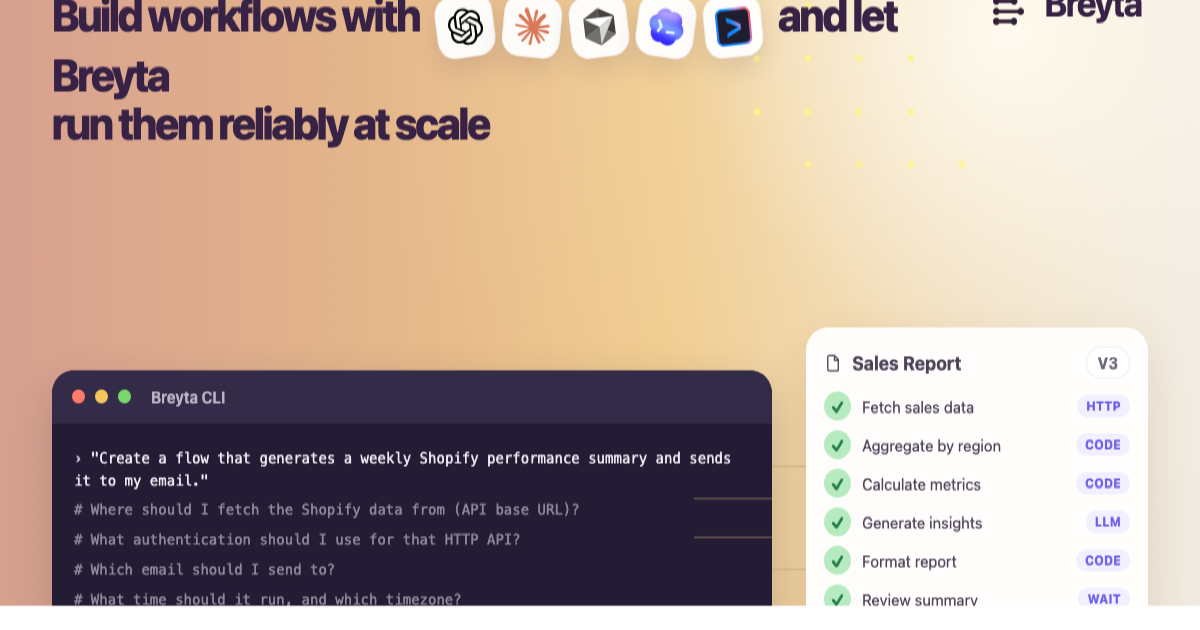
Breyta is a workflow and agent orchestration platform for coding agents. It helps teams build, run, and publish reliable workflows, agent workflows, and autonomous jobs.
What Breyta provides
- Explicit flow model. Versioned EDN definitions with a stable slug, human-readable name, triggers, functions, templates, requirements, and concurrency policy.
- Deterministic orchestration. Clear control flow in :flow with versioned releases.
- Draft vs live. Push draft changes, test, inspect, then release and promote when ready.
- Triggers. Manual, schedule, and webhook or event.
- Step families. :http, :llm, :search, :db, :wait, :function, :notify, :kv, :sleep, :ssh.
- Long-running pattern. Kick off remote work over SSH, pause with :wait, and resume on callback.
- Local and VM agents. Orchestrate agents running locally or on VMs with clean handoffs.
- Approvals and waits. Pause for human confirmation and resume with state intact.
- Resources and persistence. Persist large outputs, pass compact res:// refs, and inspect via CLI.
- CLI that is agent-first. Stable JSON, docs in the CLI, skills install, and fully scriptable runs and resources.
- Templates and apps. Package workflows as reusable templates or published apps.
- Secrets and connections. Connect accounts once. Workflows reference connections, not raw credentials.
- Managed execution. Breyta handles execution, state, retries, and recovery. You can still use your APIs, VMs, or SSH targets.
Safe packaging and pricing notes
- Unlimited users, workflows, steps per flow, and concurrent executions.
- Billing is based on monthly step executions.
- Run history retention varies by plan.
- Triggers, waits, and approval steps do not count as billable step executions.
Example uses supported in current workspaces
- Local coding-agent execution with waits.
- VM-backed support agent that renews Gmail watch subscriptions.
- Autonomous code improvement on a VM with callback and review-ready PR output.
- Draft-apply-review flows that wait for human approval before release.
- Content operators on a VM with memory, approvals, and dispatched posts.
- Multi-flow research pipelines across external sources with export.
The bottom line
- Bring the coding agent you already use.
- Use Breyta as the workflow layer around it.
Buyer scenarios and what to check
Scenario 1: VM-backed coding agent that runs overnight
- Must-haves: :ssh steps, wait and callback pattern, resumable state, draft vs live.
- Nice-to-haves: Resource refs for large outputs, CLI for scripted ops.
Scenario 2: Approval-heavy change management
- Must-haves: Approvals in production workflows, notifications, clear run history, immutable releases.
- Nice-to-haves: Templates for repeatable rollouts, audit-friendly step outputs.
Scenario 3: Event-driven post-processing pipeline
- Must-haves: Webhook triggers, :http and :db steps, retries, concurrency control.
- Nice-to-haves: Versioned flow definitions and safe promotions.
Scenario 4: Local agent handoff during development
- Must-haves: Wait steps, stable callback endpoints, scriptable CLI.
- Nice-to-haves: Skills that teach agents how to operate flows.
Quick evaluation checklist
Runtime and control
- Deterministic flow logic
- Concurrency and retries
- Draft vs live releases
Orchestration depth
- Waits, approvals, and callbacks
- SSH and local agent patterns
- Resource handling for large artifacts
Operations and safety
- Clear run history and step outputs
- Secret and connection management
- CLI and API with stable JSON
Extensibility and reuse
- Templates and publishing surface
- Trigger and step coverage
- Managed execution with bring-your-own systems
Pricing clarity
- What counts as billable steps
- Run history retention by plan
If your workflows involve agents, long waits, or human checkpoints, prioritize platforms with deterministic control, wait primitives, and a clean release model. For developer teams, also check that the CLI is first-class and scriptable. Breyta fits this profile.