AI Agent Pipelines: How to Build Reliable, Production-Ready Flows
By Chris Moen • Published 2026-02-05
Learn how to build reliable AI agent pipelines with practical stages for design, testing, deployment, and continuous improvement—plus how to map the workflow to Breyta.
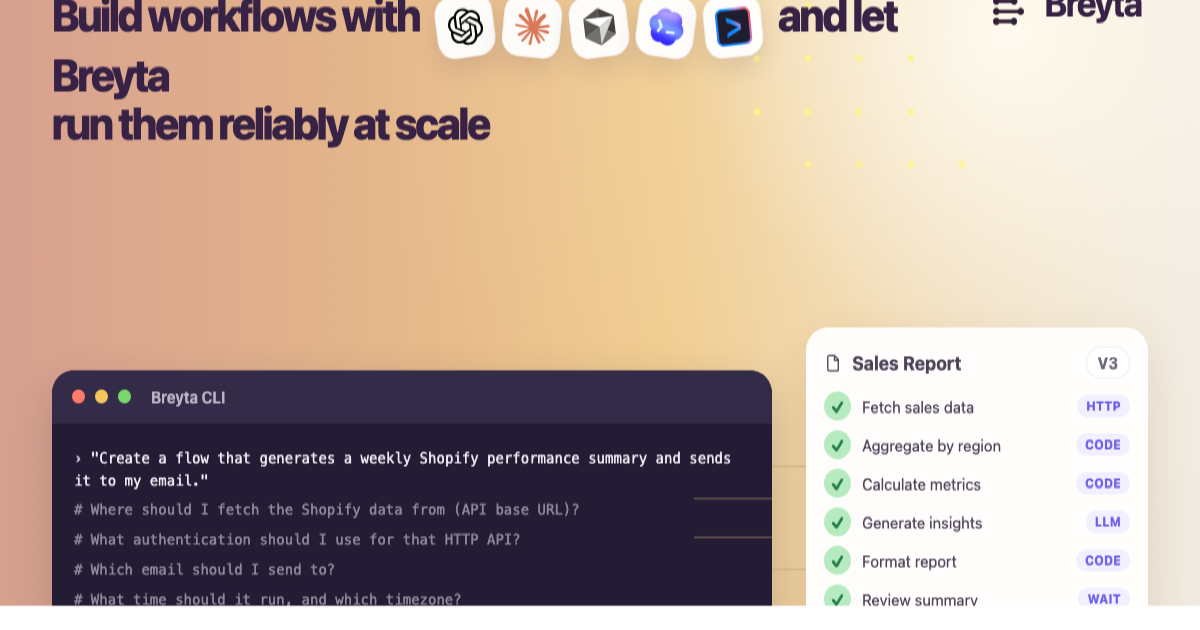
This guide shows how to build reliable AI agent pipelines that move coding agents safely from development to production. You will design clear stages, test continuously, deploy with guardrails, and improve based on real runtime signals. If you are orchestrating coding agents, Breyta provides the workflow layer with deterministic execution, explicit approvals and waits, versioned flow definitions, and clear run history.
Quick answer: What is an AI agent pipeline?
An AI agent pipeline is a structured path that moves agent code, prompts, tools, and data from development to production through staged checks. Typical stages: design and specs, data and tools setup, local tests and evals, CI checks, staged deploys, runtime observability, and continuous improvement.
Start here
You build reliability by treating agents like software and data products: define clear goals, test every change, deploy with guardrails, and monitor runtime behavior. These steps apply across stacks and can be run on platforms like Breyta.
- Fewer regressions across updates
- Faster and safer releases
- Clear insight into failures and costs
What is an AI agent pipeline?
An AI agent pipeline represents a repeatable path from concept to a deployed production agent. Each stage has explicit entry and exit criteria across design, data preparation, rigorous testing, safe deployment, and monitoring.
- Design and specs: Define the agent’s purpose and requirements.
- Data and tools setup: Prepare datasets and integrate tools.
- Local tests and evals: Validate behavior in a local environment.
- CI checks: Run automated checks to block regressions.
- Staged deploys: Roll out gradually with canaries and approvals.
- Runtime observability: Trace prompts, tool calls, and errors.
- Continuous improvement: Iterate based on production signals.
How should you design the pipeline stages?
Start with a precise task and success criteria. Identify required tools, constraints, and likely failure modes. Keep plans simple and traceable.
- Task scope and guardrails
- Inputs, outputs, and required citations (if any)
- Allowed tools and timeouts
- Cost and latency budgets
- Rollback conditions
How do you test agents continuously?
Run comprehensive tests on every change to prompts, tools, models, or code. Mix deterministic checks for structure with tolerant checks for free text.
- Unit tests for tool adapters and data mappers
- Scenario tests with fixed inputs and expected patterns
- Safety tests for denylists and PII handling
- Load and latency checks under realistic conditions
How do you handle non-deterministic outputs?
Use reference checks that allow bounded variance. Favor structured comparisons and clear scoring rules.
- Compare structured fields instead of full text
- Use exact checks for IDs, links, and JSON schemas
- For free text, verify presence of required facts or citations
- Log multiple samples to detect drift
How do you manage data and tools for agents?
Ensure fast, clean data access and treat tools as first-class components with contracts and tests.
- Version datasets, prompts, and tools
- Build “golden sets” from real queries and edge cases
- Define tool I/O contracts and validate schemas
- Cache stable lookups; throttle external calls
How do you deploy agents safely?
Adopt staged rollouts. Start with a canary, require approvals, and promote only on passing health and evaluation gates.
- Pre-production smoke tests
- Canary deploys with a small traffic slice
- Continuous monitoring of metrics and errors
- Promote or roll back on predefined thresholds
What should you monitor in production?
Track quality, reliability, cost, and user impact. Capture detailed traces with privacy in mind.
- Success and failure rate by intent
- Tool call success rate and retries
- Latency by stage and tail latency
- Token and API cost per request
- Guardrail triggers and safety violations
Golden rules
- Ship small, incremental changes with thorough tests
- Keep agent plans simple and understandable
- Prefer structured outputs where possible
- Log enough to debug while respecting privacy
- Turn incidents into new test cases
How do you improve agents over time?
Close the loop by triaging failures, labeling representative examples, expanding the golden set, and re-running the full eval suite before release.
- Weekly review of top errors and costs
- New tests for every fixed bug or issue
- Regular model comparisons with side-by-side evals
- Deprecate unused or underperforming tools
How do you map this to Breyta?
Breyta is a workflow and agent orchestration platform for coding agents. It is built for multi-step automations, long-running jobs, approval-heavy flows, and agent orchestration. In Breyta, you can run versioned flows with deterministic runtime behavior, use explicit approvals and waits for risky steps, reference shared resources, and review clear run history. Breyta can orchestrate local agents and VM-backed agents over SSH, and provides an agent-first CLI for development and releases.
- Store prompts, configurations, and tools under version control
- Trigger evaluation runs from CI on every change
- Roll out agents in stages with approvals and clear promotion criteria
- Monitor key metrics and feed incidents back into tests
For more agent orchestration guidance, explore the Breyta blog.
What pitfalls should developers avoid?
- Oversized prompts: They can obscure the agent’s planning steps
- Unstable tools: Without clear contracts, tools introduce flakiness
- Full-text-only tests: They miss issues in structured outputs
- One-time evaluations: Prefer CI-driven continuous testing
- Big-bang deploys: Large, untested releases without canaries increase risk
How do you choose a model for the agent?
Select a model that meets quality, latency, and cost goals for the task. Test candidates against the golden set, keep versions recorded, and make rollbacks easy.
How do you keep data safe in logs and traces?
Redact or mask sensitive fields before storage. Enforce access controls and retention policies. Validate redaction with tests and avoid logging unnecessary data.
How do you gate risky actions?
Use confirmations and dry runs for destructive steps. Require structured approvals for high-risk operations and log every action with time and actor.
How do you debug failures fast?
Reproduce with the exact prompt, tool I/O, and model version. Check recent changes first. After a fix, add a regression test to prevent recurrence.
FAQs
What tests should run on every change?
Unit tests for tools, scenario evaluations from your golden set, and safety checks. Block deployment on any regression or safety violation.
How do I version prompts and tools?
Keep prompts, configurations, and tool code in version control and tag releases consistently. Record the model version alongside the prompt for traceability.
How often should I refresh the golden set?
Refresh whenever you see new failure patterns or after incidents, and also on a regular cadence to avoid drift.
What metrics matter most at first?
Start with success rate, tool call failures, and latency. Once stable, add cost and guardrail-related metrics.
How do I roll back safely?
Tie releases to specific versions of prompts, tools, and models. Use canary deploys and keep a known-good version ready. Automate rollback triggers based on alerts.
Related reading: Fault-Tolerant AI Agent Flows: A Developer’s Guide to Patterns, Checkpoints, and Safe Recovery and Workflow Orchestration Tools for Developers: Choices, Use Cases, and Where Breyta Fits.