Fault-Tolerant AI Agent Flows: A Developer’s Guide to Patterns, Checkpoints, and Safe Recovery
By Chris Moen • Published 2026-02-05
A practical guide to fault tolerant AI agent flows—covering failure modes, checkpoints, idempotency, retries, approvals, and observability—so your agents fail safely and recover fast.
Agents break in the real world—because LLMs hallucinate, APIs flake, inputs are messy, and state gets out of sync. Fault tolerance isn’t a “nice to have”; it’s the difference between demo‑ware and dependable systems.
This guide distills field‑tested practices into a practical blueprint you can apply today. You’ll learn how to design AI agent flows that fail safely, recover quickly, and scale with confidence.
Quick answer: How to make AI agent flows fault tolerant
- Add checkpoints after each tool action to enable safe resume and audit.
- Use strict I/O contracts: validated schemas for every model and tool call.
- Apply retries with jittered backoff only for transient errors; require idempotency keys for writes.
- Bound behavior with timeouts, step/token budgets, and circuit breakers.
- Isolate failures via orchestrator–worker or guarded DAG architectures.
- Gate high‑impact actions with explicit approvals or human‑in‑the‑loop handoffs.
- Harden security: least‑privilege tools, prompt‑injection defenses, and PII safeguards.
- Make failures observable with structured traces, metrics, and targeted alerts.
- Continuously test: unit, contract, scenario, chaos, and canary rollouts.
Where Breyta fits
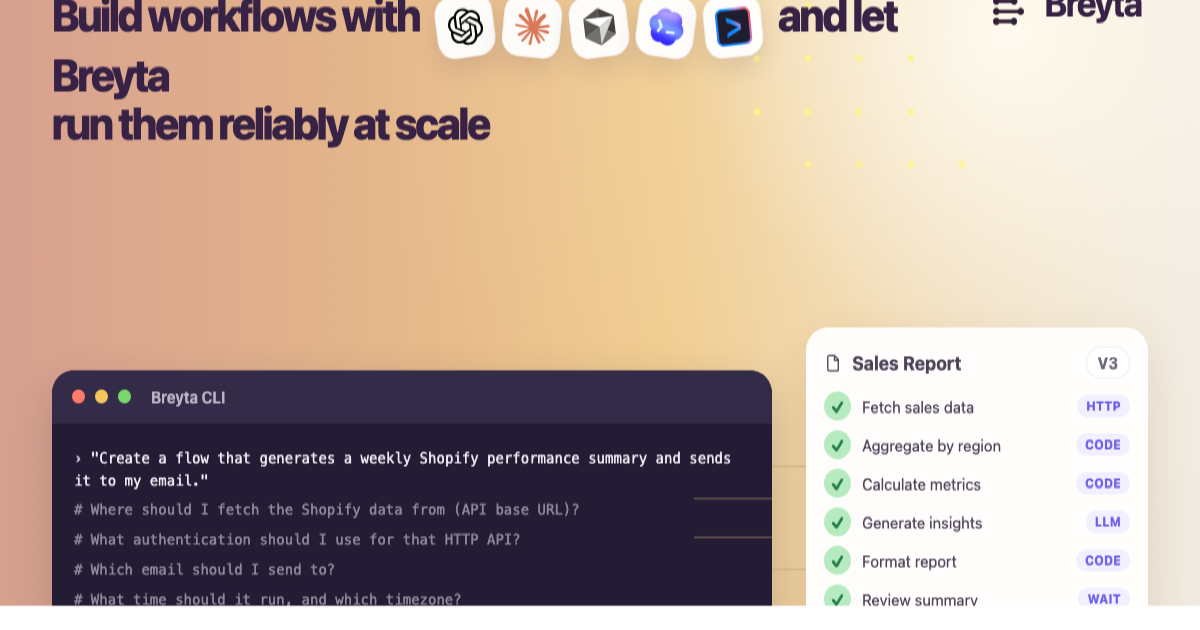
Breyta is a workflow and agent orchestration platform for coding agents. It helps teams build, run, and publish reliable workflows, agents, and autonomous jobs with deterministic execution, clear run history, versioned flow definitions, approvals, waits, reusable templates, and an agent‑first CLI. Breyta is the workflow layer around the coding agent you already use and can orchestrate local agents as well as VM‑backed agents over SSH. Use the practices below in any stack; Breyta’s deterministic runtime, explicit approvals and waits, versioned releases, and run history make these patterns easier to operate at scale.
What actually fails in agent flows
Before hardening, name the failure modes you’ll face:
- LLM issues: hallucinations, schema drift, loops, plan derailment, over‑/under‑asking clarifying questions.
- Tooling issues: HTTP 429/5xx, timeouts, flaky dependencies, schema/version changes, partial responses.
- State issues: race conditions, lost checkpoints, corrupted memory, duplicate side‑effects on retries.
- Governance issues: prompt injection, PII leakage, unexpected actions, privilege escalation.
- Product issues: ambiguous intents, missing data, long‑tail edge cases, cost/time overruns.
Your design should assume each of these will happen—then make failures observable, bounded, and recoverable.
Design principles for fault‑tolerant flows
- Keep it simple. Favor a clear DAG or bounded loop over open‑ended tool use.
- Make intent explicit. Give each flow a precise name, description, and input contract.
- Show your work. Encourage explicit planning and intermediate reasoning summaries the system can validate.
- Add a clarifier gate. Ask the minimum clarifying question needed to disambiguate user intent.
- Constrain with contracts. Define strict schemas for tool inputs/outputs and validate all model I/O.
- Prefer determinism where possible. Cap steps, set timeouts, and fix temperatures in production paths.
- Design for graceful degradation. Provide fallbacks, human handoff, or a safe summary.
Architectures that isolate failure in AI agent flows
- Orchestrator–Worker. A deterministic orchestrator runs the plan and enforces budgets; workers (LLM calls, tools) are replaceable and sandboxed.
- DAG with guards. For well‑understood workflows, encode steps as a DAG with preconditions and retry policies at each edge.
- Bounded Plan–Act–Reflect. Allow short planning bursts with a strict step budget, circuit breakers, and checkpoints between acts.
- Sagas for side effects. For multi‑service writes, use compensating steps on failure or explicit approval before irreversible actions.
Defensive prompting and I/O contracts
- System prompts: specify role, allowed tools, forbidden actions, escalation criteria, and step budget.
- Tool specs: include examples, parameter schemas, units, and guardrails (for example, customer_id must be UUIDv4).
- Output schemas: require structured JSON for plans, tool inputs, and final answers; reject or repair non‑conformant outputs.
- Grounding hints: provide retrieved facts and require answer citations when applicable.
Example tool contract (pseudo‑JSON Schema):
{ "name": "create_ticket", "input_schema": { "type": "object", "required": ["title", "priority"], "properties": { "title": {"type": "string", "minLength": 5, "maxLength": 140}, "priority": {"enum": ["low","medium","high"]}, "customer_id": {"type": "string", "pattern": "^[0-9a-fA-F-]{36}$"} } }, "idempotency_key": true, "max_retries": 2, "timeout_ms": 8000 }
Control policies that stop runaway behavior
Implement these controls centrally, not ad hoc:
- Timeouts: set at model call, tool call, and entire flow levels.
- Retries with jittered backoff: retry only on transient errors; never retry non‑idempotent side effects without an idempotency key.
- Circuit breakers: open on repeated tool or model errors; route to fallback or human.
- Budgets: cap tokens, steps, tool invocations, wall‑clock time, and total cost per run.
- Rate limits and bulkheads: isolate high‑risk tools or tenants so one failure doesn’t cascade.
- Quotas per user/session: prevent accidental abuse or prompt‑injection loops.
Minimal retry policy:
retry_if: [timeout, http_429, http_5xx, tool_unavailable] max_attempts: 3 backoff: base=0.5s, factor=2.0, jitter=full idempotent_required_for_retry: true
Idempotency, side effects, and compensation
- Idempotency keys: generate one per user intent or saga step; pass through to downstream systems and store responses to dedupe.
- Outbox pattern: write intent to a durable store; a worker performs the external call and records the result atomically.
- Compensating actions: define explicit undo for each side effect (refund, status revert). Require human confirmation when compensation is risky.
- Exactly‑once semantics are aspirational. Aim for at‑least‑once with idempotency or safe retries or at‑most‑once with clear user feedback and recovery paths.
State, memory, and checkpoints
- Separate ephemeral run state (plan, step logs) from durable memory (facts, user profile).
- Checkpoint after each tool action: persist plan, inputs, outputs, and decisions for replay and audit.
- Version schemas: migrate carefully; keep backward‑compat parsers.
- Concurrency control: lock conversational sessions or use sequence numbers to prevent interleaved steps.
- Don’t trust model “memory.” Make retrieval explicit and test for missing context.
Security and safety
- Least privilege for tools: narrow scopes, short‑lived tokens, audited access.
- Prompt‑injection defenses: prefix‑suffix prompting, input segmentation, and allowlist which inputs get passed to tools.
- PII controls: redact before logging, encrypt at rest and in transit, segregate sensitive spans.
- Action gating: require human approval or policy checks before high‑impact operations.
- Model hygiene: set conservative temperature for critical paths; use grounding checks before executing risky tool calls.
Observability: make failures loud and useful
Instrument like you would a distributed system:
- Structured traces: each step is a span with inputs, outputs, tokens, latencies, cost, and decision metadata.
- Metrics: success rate, escalation rate, loop aborts, tool error rate, groundedness coverage, answer quality score, cost per resolution.
- Logs: redact sensitive fields; keep full tool payloads when allowed for debugging.
- Live dashboards: per‑tenant SLOs and budget burn charts.
- Alerting: on circuit breaker open, step budget exceeded, or unusual error clusters.
Testing and evaluation
- Unit tests: deterministic prompts with fixed seeds and tool stubs; validate schema conformance and branching logic.
- Contract tests: for each tool, verify schema, error mapping, retries, and idempotency.
- Scenario suites: include happy paths and adversarial cases (ambiguous intents, rate limits, malformed data, prompt injection).
- Golden runs: snapshot known‑good traces; diff future runs for regressions.
- Continuous testing: run the suite on every model, prompt, or tool update. Shadow test new agents on real traffic. Canary rollout with kill switches.
- Offline evals: use labelers or scoring functions for groundedness, factuality, and coverage. Keep a benchmark set per flow.
- Chaos tests: inject timeouts, 5xx, and slow tools to ensure budgets and fallbacks work.
Environment hardening
- Network isolation for orchestrator/worker services.
- TLS and custom CA certs where required; pin outbound endpoints for critical tools.
- Fix base URLs and timeouts; don’t rely on library defaults.
- Rotate and encrypt API keys; set explicit encryption keys for local secrets.
- Configure workflow timeouts centrally; verify they propagate to model and tool calls.
Human‑in‑the‑loop and graceful degradation
- Clarify step: when confidence or plan quality is low, ask one targeted question before branching.
- Fallback modes:
Simplified retrieval‑only answer with citations.
- Communicate safe failure: “I can’t complete this safely. Handing off to a human.” with a helpful summary.
- Alternate model or cached answer if appropriate.
- Handoff packet: include user intent, plan, executed steps, errors, and suggested next actions.
A reference blueprint (pseudo‑YAML)
agent_flow: name: "refund_request_v1" description: "Validate eligibility and process refunds with approvals" inputs_schema: { order_id: string, reason: string } budgets: { steps: 8, tokens: 16k, wall_clock_s: 45, cost_usd: 0.15 } clarifier_gate: condition: "missing order_id OR ambiguous reason" question: "Could you share the order ID and whether the item was defective, late, or other?" max_attempts: 1 plan: model: "gpt-4o-mini" # or your platform’s chosen model output_schema: [steps[] { goal, tool, inputs_schema_ref }] execution: retry_policy: { max_attempts: 3, backoff: exp_jitter, retry_if: [timeout, 429, 5xx] } circuit_breakers:
- tool: "payments.refund"
open_after: 4 errors/60s fallback: "create_handoff_ticket" step_timeout_s: 8 validators:
- json_schema_validator
- business_rules_validator
- grounding_check(retrieval_required=true)
tools:
- name: "orders.fetch"
idempotent: true
- name: "eligibility.evaluate"
idempotent: true
- name: "payments.refund"
idempotent: true requires_approval_if: amount > 200 compensate: "payments.issue_charge"
- name: "support.create_ticket"
idempotent: true persistence: checkpoint_each_step: true redact_fields: ["customer_email", "card_last4"] fallbacks:
- on: "budget_exceeded | circuit_open | validator_fail"
action: "support.create_ticket" metrics:
- success_rate
- escalation_rate
- avg_cost
- tool_error_rate
Metrics that matter
- Task success/deflection rate
- First response time and time‑to‑resolution
- Human handoff rate and reasons
- Token, latency, and cost budgets per resolved task
- Retry rate by tool and model
- Groundedness/coverage (answers backed by retrieved facts)
- Loop aborts and circuit breaker opens
A minimal hardening checklist
- Define flow name, description, and input/output schemas.
- Add a clarifier gate before conditional branches.
- Set timeouts, retries with jittered backoff, and a step/token budget.
- Enforce idempotency keys for any external write.
- Validate all model outputs against strict schemas.
- Sandbox tools with least privilege; mask secrets and PII in logs.
- Add circuit breakers and fallbacks (alternate model or human handoff).
- Instrument traces, metrics, and alerts; build a regression suite.
- Shadow test and canary deploy changes; keep kill switches ready.
- Document a runbook for incidents and compensations.
Putting it together
Fault‑tolerant AI agent flows look less like “smart prompts” and more like resilient distributed systems: explicit contracts, bounded loops, idempotency, observability, and continuous testing. Start with a small, well‑scoped flow, wire in the controls above, and expand carefully. The payoff isn’t just fewer incidents—it’s faster iteration, lower costs, and trust from your users and stakeholders.
FAQ
How do I stop agents from getting stuck in loops?
- Cap the step count and wall‑clock time.
- Track repeated tool inputs; abort on duplicate consecutive actions.
- Add a no‑progress detector that compares successive states and triggers a fallback.
- Lower temperature and require a brief plan before each act step.
When should I use a DAG vs. a planning agent?
- Use a DAG when the workflow is well understood with clear branches and validations (support procedures, KYC, RAG Q&A).
- Use a bounded planner when steps genuinely depend on emerging context across tools.
- A hybrid often works best: DAG for guardrails, small planning bursts within nodes.
How do I safely retry actions that cause side effects?
- Require idempotency keys and pass them through to downstream systems.
- Retry only on transient errors (timeouts, 429/5xx) and only when the operation is idempotent.
- For non‑idempotent actions, use an outbox pattern or escalate to human approval.
What temperatures and decoding settings should I use in production?
- For critical paths, use low temperature (0–0.3) and possibly top_p around 0.8 to reduce variance.
- For brainstorming/planning stages, you can increase temperature slightly, but keep the act phase conservative.
- Always pin settings in production and test changes behind canaries.
How do I test agents reliably when LLM outputs are stochastic?
- Fix seeds where supported and stub tool calls for unit tests.
- Validate structure and decision logic instead of exact wording.
- Use golden traces for end‑to‑end comparison and tolerate minor text diffs.
- Add offline evaluators for groundedness and task completion, not just string equality.
What are the first practical steps to make an existing agent flow fault‑tolerant?
- Inventory failure modes for that flow (LLM, tools, state, security).
- Add explicit input/output schemas and validators for every tool and plan.
- Introduce clarifier gates, step/time budgets, and idempotency keys for writes.
- Implement checkpointing and structured tracing so you can replay and debug.
How should I handle schema changes in tools or models?
- Version your schemas and accept only declared versions; keep parsers backward‑compatible.
- Run contract tests and schema migrations in a canary environment before rolling out.
- Provide graceful fallbacks for older formats and log schema mismatches for analysis.
- Automate diffs between golden traces to spot regressions early.
How do I decide when to escalate to a human vs. automated retries?
- Define escalation thresholds: repeated transient failures, validator failures, or non‑idempotent actions that can’t be reconciled.
- Use confidence/grounding checks and business rules to surface high‑risk cases.
- Attach a concise handoff packet (intent, plan, steps, errors) to minimize manual triage time.
- Prefer short automated retries for transient errors; escalate when compensation or approval is required.
Related reading: AI Agent Build Patterns: Reliable execution loops, tooling, and production practices and Reliable Agent Workflows: Design, scale, and observe coding agents with confidence.