Workflow Orchestration Tools for Developers: Choices, Use Cases, and Where Breyta Fits
By Chris Moen • Published 2026-03-14
A developer-first guide to workflow orchestration tools: how they differ, what to evaluate, common engineering use cases, and when to choose Breyta for agent and long-running job orchestration.
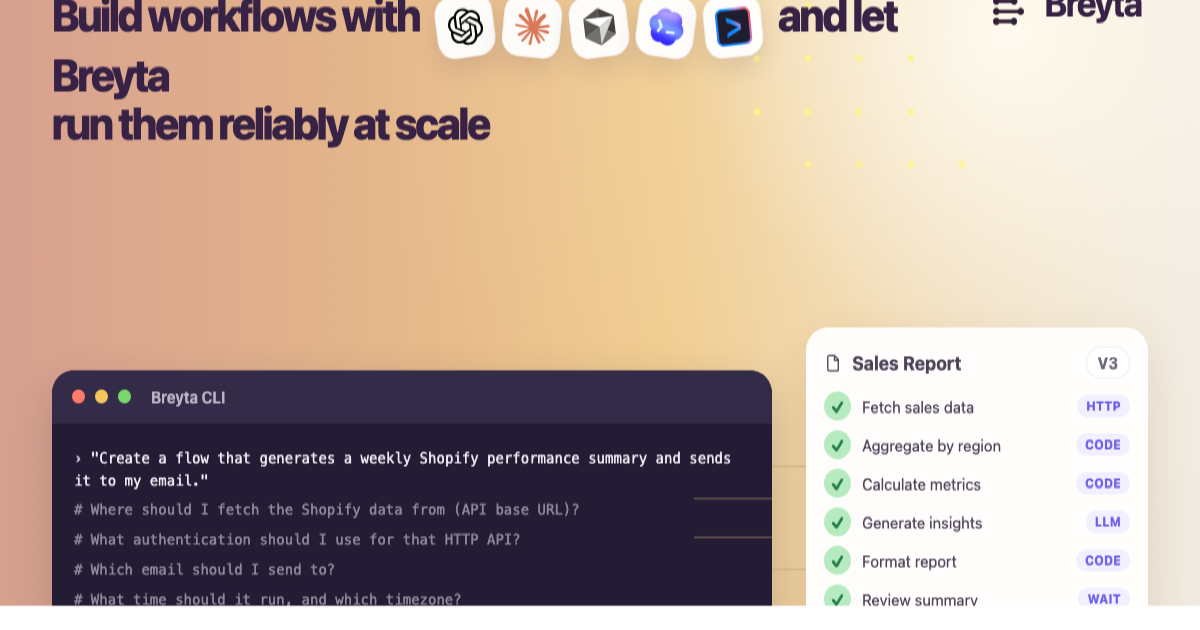
Developers reach for workflow orchestration tools when one-off scripts and cron jobs stop being enough. This guide focuses on the tools landscape and concrete developer use cases—so you can pick the right fit for your stack, your run-time requirements, and your team’s ops model.
Quick answer
Workflow orchestration tools for developers fall into a few buckets:
- Code-first workflow engines embedded in apps (e.g., stateful SDK-driven orchestrators)
- DAG-centric data and ML orchestrators
- Kubernetes-native job orchestrators for containers
- CI/CD runners for repo-centric automation
- Cloud service orchestrators for serverless steps
- Agent and workflow orchestration layers built for long-running jobs, approvals, and agent coordination (Breyta)
Choose based on how you run code (in-app, container, serverless, VM), how long it runs (seconds to days), your need for approvals and waits, and how strictly you need deterministic, versioned execution and run history.
What developers mean by “workflow orchestration”
At a high level, orchestration coordinates multiple tasks across systems so they execute in the right order with the right inputs and handoffs. It is broader than a single automation: it manages dependencies, state, retries, human approvals, and auditability from start to finish (see overviews from organizations like IBM and TechTarget).
The landscape of workflow orchestration tools for developers
- Code-first workflow engines
Good for workflows authored as code and running inside your services.
- Use when you need strongly consistent, stateful control flow and retries within application boundaries.
- DAG-centric data/ML orchestrators
Good for batch pipelines, transformations, and ML stages with clear task graphs.
- Use when you primarily schedule and monitor jobs across data platforms.
- Kubernetes-native job orchestrators
Good for containerized steps, fan-out/fan-in, and cluster-level scheduling.
- Use when you manage workloads as Kubernetes jobs and need declarative graphs.
- CI/CD runners
Good for repo-triggered automation tied to branches, PRs, and releases.
- Use for build/test/deploy and lightweight operational tasks near source control.
- Cloud service orchestrators
Good for serverless steps across managed services with built-in scaling.
- Use when you want event-driven flows inside a single cloud provider.
- Agent and workflow orchestration around coding agents
Good for multi-step automations, long-running and VM-backed jobs, and human-in-the-loop gates.
- Use when you need deterministic runs, clear history, versioned flow definitions, approvals, explicit waits, and agent-friendly tooling. This is where Breyta focuses.
How to choose: developer evaluation checklist
- Deterministic execution and state: Steps run in a defined order with clear dependencies and stored state.
- Versioning and releases: Ability to iterate in draft and promote immutable releases that runs are pinned to.
- Run history and observability: Step-by-step inputs/outputs, logs, and a clear audit trail.
- Approvals and explicit waits: First-class human checkpoints and pause/resume patterns.
- Long-running jobs: Reliability across hours or days without holding fragile connections open.
- Remote and VM execution: Orchestrate local agents and VM-backed agents over SSH when needed.
- Error handling and recovery: Retries, timeouts, idempotency, and safe replays.
- Triggers and concurrency policies: Clear entry points, rate limits, and safe parallelism.
- Secret and resource handling: Keep credentials out of code and pass large artifacts by reference.
- CLI and API ergonomics: Scriptable control with stable, machine-parsable output for tools and agents.
- Templates and reuse: Package and share proven patterns to reduce boilerplate.
Developer use cases and sample workflows
- Repository ops and change automation
Trigger on webhook or manual run, validate inputs, open a branch, propose edits, request approval, apply if approved, notify.
- Data and post-processing pipelines
Ingest a file, validate rows, call external APIs, persist results, and generate a report with a clear audit trail.
- Long-running ML or batch jobs
Kick off training on a VM, pause the workflow, resume on callback, collect metrics, and store artifacts as references.
- Agent-in-the-loop automations
Fetch context, let a coding agent propose a change, require a human approval, then execute and publish.
- Operational runbooks with checkpoints
Validate preconditions, apply guarded changes, wait for signals, roll forward/back based on approval.
Where Breyta fits
Breyta is a workflow and agent orchestration platform for coding agents. It helps teams build, run, and publish reliable workflows, agents, and autonomous jobs with deterministic execution, clear run history, versioned flow definitions, approvals, waits, reusable templates, and an agent-first CLI. Breyta is the workflow layer around the coding agent you already use, and it can orchestrate local agents and VM-backed agents over SSH.
For multi-step automations, long-running jobs, and approval-heavy flows, Breyta provides deterministic runtime behavior, explicit approvals and waits, versioned releases, resource references, and a clear run history—so developers can iterate safely, promote with confidence, and operate with auditability.
Example: Orchestrating a coding agent with Breyta
- Trigger on a webhook when a change request arrives.
- Validate inputs and fetch context via HTTP and database lookups.
- Start a local or VM-backed coding agent over SSH to propose a change.
- Persist large artifacts as resources and pass compact references through the flow.
- Insert an approval step to gate risky actions.
- Resume deterministically, apply changes, and notify stakeholders.
The agent-first CLI returns stable, parseable output that coding agents and scripts can consume, making it straightforward to author, run, inspect, approve, and release flows from the command line.
Quick comparison: when to prefer which approach
- Embedded, code-first engines: Use when workflows live inside your service and you need SDK-driven state and retries.
- DAG-oriented data/ML orchestrators: Use for batch data transforms and model stages with well-defined task graphs.
- Kubernetes job orchestrators: Use for containerized fans and cluster scheduling.
- CI/CD runners: Use for repo-centric automation alongside builds and deployments.
- Cloud service orchestrators: Use for serverless, event-driven steps within a provider ecosystem.
- Breyta: Use when you need a workflow layer around coding agents, plus deterministic execution, approvals and waits, versioned releases, resource references, clear run history, and the ability to orchestrate work on local machines and VMs over SSH.
FAQ
What is the difference between automation and orchestration?
Automation performs a single task. Orchestration coordinates many tasks across systems within a defined workflow, managing state, dependencies, and handoffs across the full run (see TechTarget’s overview).
Is orchestration the same as scheduling?
No. Scheduling triggers jobs on a time or event. Orchestration manages the entire workflow lifecycle, including dependencies, retries, waits, and approvals.
Do I need Kubernetes to use an orchestrator?
No. Many developer workflows run against APIs, VMs, or local agents. Choose tooling that aligns with where your code actually runs.
How do coding agents fit into orchestration?
Agents perform tasks like proposing changes or drafting outputs. The orchestrator provides the structure around them: triggers, long-running execution with explicit waits, human approvals, versioned releases, and a clear run history. Breyta focuses on that orchestration layer for coding agents.