Breyta vs Zapier vs Make for Developers: Quick picks, examples, and when to use each
By Chris Moen • Published 2026-03-04
Quick answer for developers: use Zapier for fast SaaS glue, Make for visual, branch‑heavy API work, and Breyta when you need a workflow and agent orchestration layer around the coding agent you already use—built for multi‑step, long‑running, approval‑heavy jobs with deterministic execution, clear run history, versioned flow definitions, waits, and an agent‑first CLI.
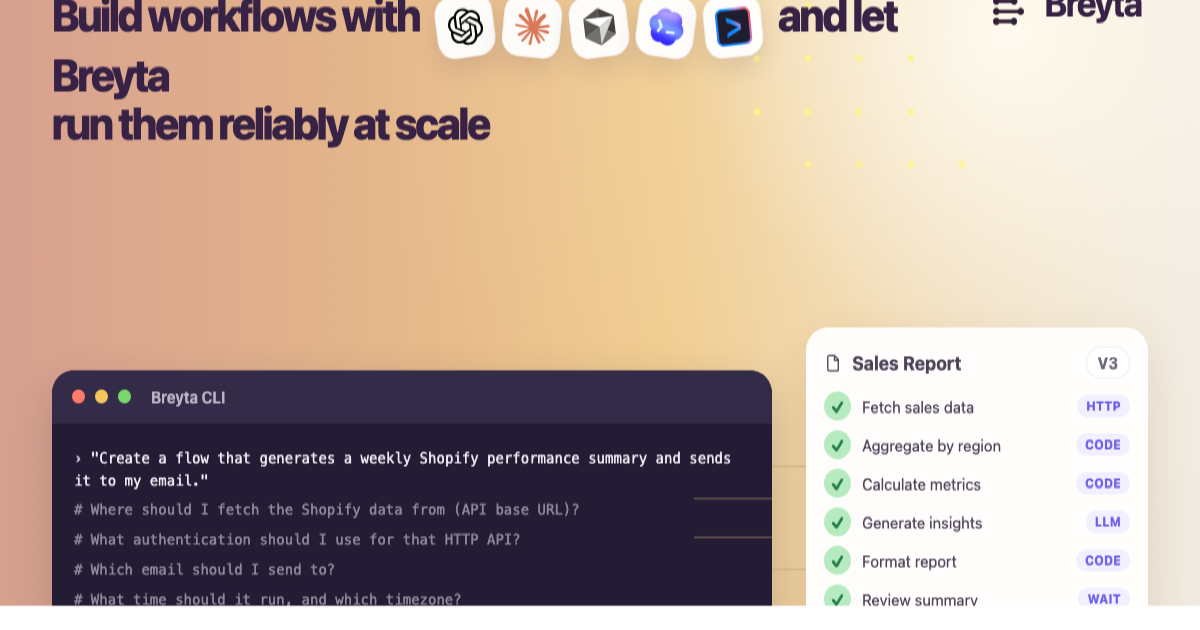
Quick answer for developers: choose Zapier for fast app-to-app automations, Make for complex visual API scenarios, and Breyta when you need a workflow and agent orchestration layer around the coding agent you already use—especially for multi-step, long-running, approval-heavy jobs with deterministic execution, clear run history, waits, and versioned flow definitions.
Disclosure: Breyta is our product.
What each platform is
Breyta is a workflow and agent orchestration platform for coding agents. It helps teams build, run, and publish reliable workflows, agents, and autonomous jobs with deterministic execution, clear run history, versioned flow definitions, approvals, waits, reusable templates, and an agent-first CLI. It can orchestrate local agents and VM-backed agents over SSH.
Zapier focuses on quick, no-code app automations. It’s broadly adopted for connecting SaaS tools via triggers and actions with minimal setup.
Make focuses on complex, visual workflows. It provides granular branching, iteration, and detailed data mapping for API-heavy scenarios.
Developer quick picks
- Choose Zapier when you need speed and simplicity across common SaaS apps—alerts, handoffs, and lightweight syncs you can stand up in minutes.
- Choose Make when you need deep branching, array handling, and custom API calls in a visual builder with fine-grained data mapping.
- Choose Breyta when your core workload is a coding agent and you need reliable, repeatable orchestration for multi-step and long-running jobs with explicit approvals and waits, deterministic execution, clear run history, and versioned flow definitions.
Concrete workflow examples
- Breyta: Coordinate a coding agent to generate code changes across multiple repositories, open draft pull requests, pause for human approval, then continue to merge and notify—each run tracked with versioned flow definitions and a clear audit trail.
- Zapier: On a new Typeform submission, create a record in your CRM, enrich via a connector, and post a Slack message to a channel.
- Make: Receive a webhook, branch on conditions, iterate over an array of items, transform JSON fields, and call multiple APIs with custom headers and mappings.
Key differences that matter to developers
Runtime behavior and reliability
Breyta provides deterministic execution with clear run history and controls like approvals and waits. Zapier and Make both aim for reliable runs; reliability often depends on connector coverage, plan limits, and your error handling.
Versioning
Breyta supports versioned flow definitions so you can track and manage changes to agent workflows. Zapier and Make support revisions to automations; confirm version controls per tool if you need strict change management.
Human-in-the-loop
Breyta includes explicit approvals and waits for gated steps in agent workflows. Zapier and Make can pause or request input via patterns and connectors; depth varies by plan and implementation.
Execution environment
Breyta can orchestrate local agents and VM-backed agents over SSH, with an agent-first CLI to build and operate flows. Zapier and Make run in managed cloud environments; code steps and webhooks extend functionality within those environments.
Data shaping and mapping
Make excels at visual data mapping, branching, and array handling for API-heavy scenarios. Zapier favors simpler mappings for common business flows. Breyta centers on orchestrating coding agents; use it when the agent’s work is the core of the job rather than heavy visual data shaping.
Connectors and extensibility
Zapier offers a large catalog of app connectors with triggers/actions and webhooks. Make provides built-in modules and a flexible HTTP module for custom endpoints. Breyta is the workflow layer around the coding agent you already use, with deterministic runtime behavior and clear run history.
Pricing and limits (check vendor sites)
These tools use plan- and usage-based pricing. Exact prices, limits, and feature gates change. Check each vendor’s site before you decide.
AI, agents, and data-heavy work
- Use Make for data-heavy flows that need parsing, iteration, and complex mapping in a visual canvas.
- Use Zapier for fast app connections when you prioritize speed over deeply custom data handling.
- Use Breyta when the core workload is a coding agent and you need reliable, repeatable orchestration with versioned flow definitions, explicit approvals and waits, and clear run history—suitable for long-running and autonomous jobs.
Other automation alternatives
- Microsoft Power Automate: deep Microsoft 365 and Dynamics ties
- n8n: open source and self-host options
- Pipedream: developer-friendly with code-centric flows
- Workato: enterprise automation and governance
- IFTTT: simple consumer and IoT links
How to decide in 10 minutes
- List your top three workflows, owners, and SLAs.
- Match complexity to builder skill:
If business users must build quickly with common apps, lean to Zapier.
- If operators need visual, branch-heavy API scenarios, lean to Make.
- If developers run coding agents and need deterministic, long-running orchestration with approvals and versioned flow definitions, lean to Breyta.
- Verify requirements:
Connector coverage and plan limits (Zapier/Make).
- Agent orchestration needs (Breyta): approvals, waits, environment access, versioned flow definitions, and run history.
FAQ
How hard is it to switch between these tools?
It depends on workflow complexity. Simple zaps or scenarios can be rebuilt in hours. Complex API-heavy or agent-driven flows can take longer due to mapping, orchestration, and testing.
Can I use more than one tool at the same time?
Yes. Many teams combine tools—for example, Zapier for quick SaaS automations, Make for complex visual scenarios, and Breyta as the orchestration layer around coding agents.
Which tool is best for reliability?
All three aim for reliable runs. Reliability depends on plan limits, connector quality, and your error handling. Breyta provides deterministic execution with clear run history. Add retries and alerts regardless of tool.
Do these tools support webhooks and APIs?
Zapier and Make both support webhooks and API calls. Breyta focuses on orchestrating coding agents with deterministic runtime behavior and can orchestrate local agents and VM-backed agents over SSH. Refer to each product’s documentation for specific interfaces.
Which is better for teams with strict security needs?
Check each vendor’s security and compliance documentation. Self-hosting options like n8n can also help if you need full control. Always confirm with your security team.