Breyta Launch: CLI-First AI Workflows for Coding Agents
By Chris Moen • Published 2026-02-27
Why CLI-first AI workflows fit coding agents, and how Breyta’s agent-first CLI brings deterministic execution, approvals, versioned releases, resource refs, and clear run history—right from the terminal.
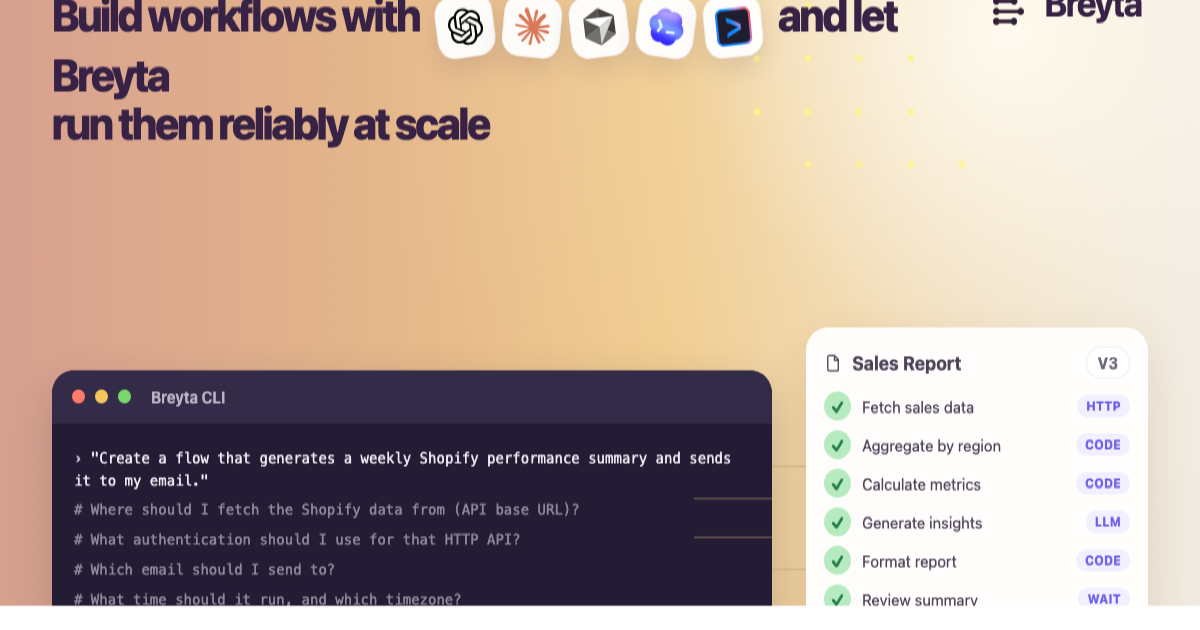
Breyta is a workflow and agent orchestration platform for coding agents. We’re launching a CLI-first experience so teams can build, run, and publish reliable automations from the terminal—where both developers and coding agents already work.
Quick answer: Why CLI-first AI workflows
- Works where developers and coding agents already operate: the terminal.
- Deterministic runtime behavior and versioned releases keep runs repeatable.
- Clear run history, explicit approvals, and waits give teams control.
- Orchestrates local agents and VM-backed agents over SSH.
- Resource refs and reusable templates reduce glue work.
- Built for multi-step automations, long-running jobs, and approval-heavy flows.
Why we changed direction
We shipped an early version of agents and saw a clear pattern: static workflow setup created friction. Teams didn’t want to keep adjusting a predefined configuration every time needs changed.
They wanted to work with a coding agent like a teammate—iterate in real time, inspect why output was produced, refine the result step by step, and deliver outcomes into the systems they already use.
What “CLI-first” means in practice
You describe the task. The coding agent you already use does the work. Breyta provides the workflow layer around it.
No drag-and-drop builders to maintain. No extra diagrams. No brittle handoffs.
Breyta now ships with an agent-first CLI that lets technical users build, run, and publish workflows and autonomous jobs with deterministic execution, clear run history, versioned releases, explicit approvals and waits, resource refs, and reusable templates. You can orchestrate both local agents and VM-backed agents over SSH, while keeping a transparent record of what ran and why.
From idea to working integrations
With a CLI-first approach, you can move from an idea to a reliable, multi-step workflow quickly:
- Sketch the flow in small, deterministic steps that call external APIs or run code.
- Wire those steps into a Breyta workflow with resource refs and explicit approvals or waits where needed.
- Iterate in the terminal with your coding agent, then publish a versioned release when it’s ready.
- Run it reliably with clear run history for review and audits.
This approach makes it practical to support long-tail automations—not just the most common SaaS pairings.
A real internal example
Internally, we orchestrate a workflow that forwards purchase receipts to an inbox, triggers a Breyta workflow, analyzes PDF content with an LLM, cleans fields with code, prepares payloads, and posts entries to our accounting system via API calls. The value isn’t a single static flow—it’s how quickly the flow can be refined as real-world edge cases appear, while keeping deterministic behavior and a clear run history.
What this launch is about
This launch isn’t about turning users into workflow engineers. It’s about giving teams a reliable workflow layer around the coding agent they already use—so they can delegate confidently while staying in control of outcomes.
Install Breyta and start with one recurring task you already repeat every week.
Related reading: Workflow Orchestration Tools for Developers: Choices, Use Cases, and Where Breyta Fits and Breyta SRE: A Practical Guide to SRE for AI Agents and Workflows.