The best n8n alternative for developers: Breyta vs n8n
By Chris Moen • Published 2026-03-14
If you’re a developer choosing an n8n alternative, use Breyta when your workflows center on coding agents, long-running jobs, approvals, and versioned releases. Use n8n when you need visual automations and broad integrations.
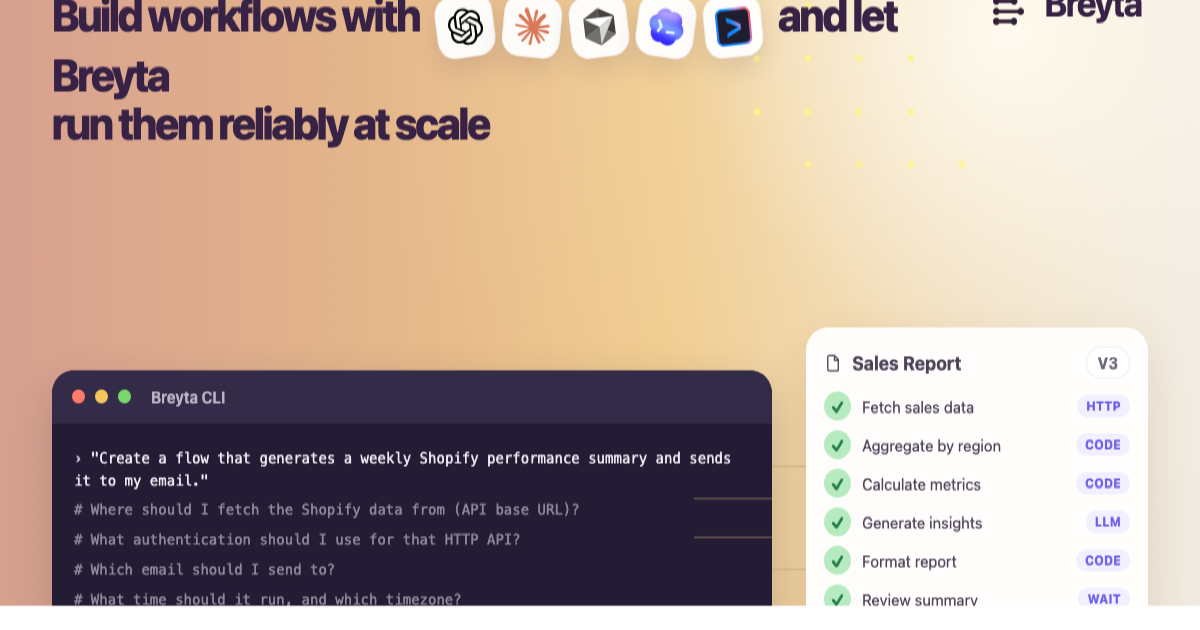
Looking for an n8n alternative for developers? Here’s the quick take: pick Breyta when your core work is running coding agents with reliable, versioned workflows and human-in-the-loop steps. Pick n8n when you want a visual automation tool with broad connectors for common integrations.
Disclosure: Breyta is our product.
Quick answer
- Choose Breyta if you need a workflow and agent orchestration platform for coding agents with deterministic execution, approvals, waits, versioned releases, clear run history, reusable templates, and an agent-first CLI.
- Choose n8n if you want a visual, general-purpose automation tool for integrations, API calls, webhooks, and event-based tasks.
What each tool is
- Breyta: A workflow and agent orchestration platform for coding agents. It is built for multi-step automations, long-running jobs, approval-heavy flows, and agent orchestration. Breyta provides deterministic runtime behavior, explicit approvals and waits, versioned releases, resource refs, clear run history, and an agent-first CLI. It can orchestrate local agents and VM-backed agents over SSH. Learn more about the workflow layer in our overview of workflow orchestration and our guide to CLI-first agent workflows.
- n8n: An open-source automation tool for workflows and integrations. It is well-suited for wiring APIs, building visual automations, and reacting to events and schedules through a node-based editor.
When to pick Breyta vs n8n
- Pick Breyta when your workflows:
Run coding agents that perform multi-step tasks across repos, services, and environments.
- Need long-running execution with explicit waits and human approvals before changes land.
- Require deterministic runs, versioned releases, and clear, inspectable run history.
- Handle large artifacts via resource refs without bloating in-flow state.
- Need to orchestrate local or VM-backed agents over SSH.
- Pick n8n when your workflows:
Focus on connecting services quickly via a visual builder and ready-made nodes.
- Center on API calls, data transforms, webhooks, and event-driven automations.
- Are best expressed and shared as visual canvases for cross-functional teams.
Developer use cases, side by side
- Breyta examples
Repository-wide agent updates with approvals: an agent proposes refactors across multiple repos, runs checks on a VM over SSH, waits for a human approval, and then proceeds.
- Autonomous maintenance jobs: a coding agent performs a weekly task (e.g., code hygiene, dependency updates), uses waits between steps, and ships via a versioned release.
- Production change workflows: an agent prepares changes, pauses for review, and resumes only after approval, with full run history and outputs preserved via resource refs.
- n8n examples
Service-to-service glue: trigger on a webhook, enrich with an API call, then notify a channel.
- Scheduled data tasks: poll an API, transform results, and send to another system on a schedule.
- Lightweight event routing: route events between tools using a visual node editor.
Key differences developers feel
- Orientation
Breyta: agent-first and CLI-friendly, built as the workflow layer around the coding agent you already use.
- n8n: visual-first with a node-based editor and many connectors.
- Runtime behavior
Breyta: deterministic execution with versioned releases and clear run history.
- n8n: visual workflow runtime oriented around integrations and event handling.
- Long-running work
Breyta: explicit waits and resumes, suitable for orchestrating local or VM-backed agents over SSH.
- n8n: strong fit for API-driven and event-based steps that complete quickly.
- Human-in-the-loop
Breyta: first-class approvals and waits for safe changes.
- n8n: human review can be modeled in flows, typically via custom steps and integrations.
- Artifacts and outputs
Breyta: resource refs enable passing references to large outputs without inflating in-flow state.
- n8n: optimized for typical payload sizes in integrations and automations.
How Breyta and n8n can work together
Both can be used side by side. Breyta can run the structured, deterministic workflow around your coding agent, while n8n can handle surrounding service integrations and notifications. For deeper background on reliable agent workflows, see our guide on reliable, scalable, observable agent workflows.
How to choose in under a minute
- If your critical workflows are agent-driven, long-running, or require approvals and versioned releases with clear run history, choose Breyta.
- If your main need is visual automations and service-to-service integrations, choose n8n.
FAQ
Does Breyta include a coding agent?
No. Bring the coding agent you already use. Breyta is the workflow layer around it via an agent-first CLI. For details, read CLI-first agent workflows.
Can Breyta orchestrate agents on my own machines?
Yes. Breyta can orchestrate local agents and VM-backed agents over SSH, with explicit waits for long-running steps.
How does Breyta reduce risk in production workflows?
Breyta provides deterministic execution, explicit approvals and waits, versioned releases, resource refs, and clear run history so runs are inspectable and changes move safely.
Related reading: Breyta vs Zapier vs Make for Developers: How to choose agent orchestration vs no‑code automation and Designing Fault-Tolerant AI Agent Flows: A Developer's Guide.