SRE for AI Agents: A Practical Guide to Reliable Agent Workflows
By Chris Moen • Published 2026-02-27
A practical guide to SRE for AI agents and workflows. Get a quick answer, concrete SLIs/SLOs, instrumentation tips, safe scaling patterns, and incident playbooks. See where Breyta—the workflow and agent orchestration layer for coding agents—fits.
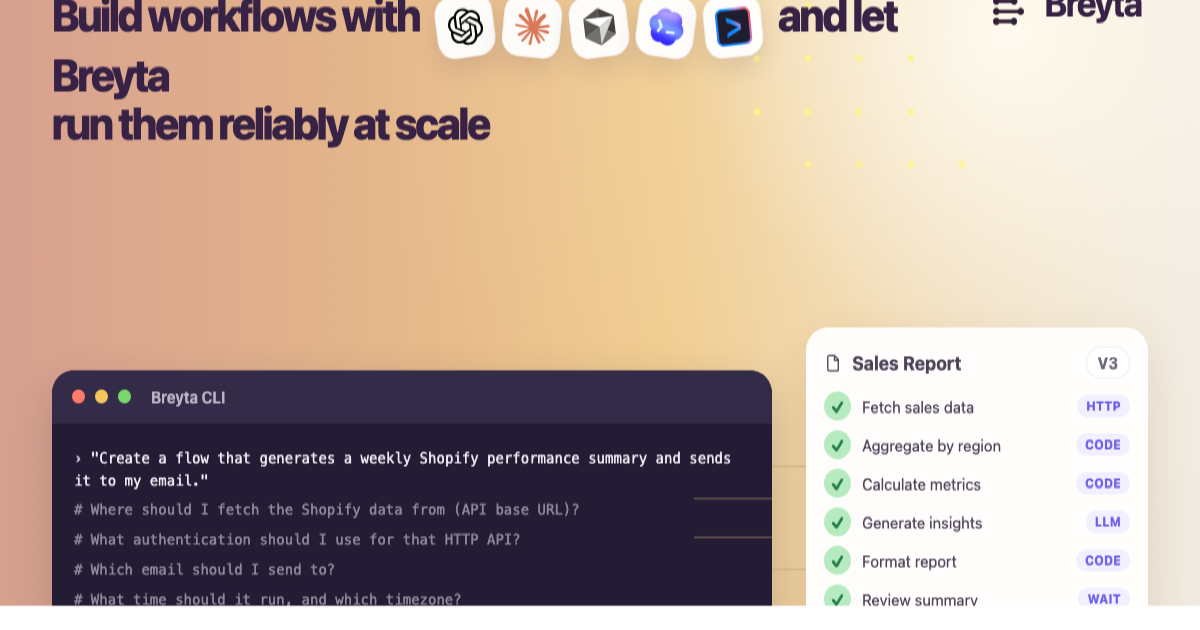
This guide applies site reliability engineering (SRE) to AI agents and multi-step workflows. It focuses on observability, safe scaling, and incident response, with concrete steps you can use today.
Quick answer: What is SRE for AI agents?
- Treat agents, tools, and steps as production services with clear SLIs/SLOs.
- Instrument prompts, tools, and decisions with traces, metrics, and structured logs.
- Version and gate changes (prompts, models, tools) with approvals, rollbacks, and run history.
- Scale safely with idempotency, backpressure, and rate limits across providers.
- Protect data quality with validations, guardrails, and auditability at each boundary.
- Run incident response with fast triage, safe fallbacks, and clear owners.
Where Breyta fits
Breyta is the workflow and agent orchestration platform for coding agents—the workflow layer around the agent you already use. It helps teams build, run, and publish reliable multi-step automations and long-running jobs with deterministic execution, clear run history, versioned flow definitions, explicit approvals and waits, reusable templates, and an agent-first CLI. Breyta can orchestrate local agents and VM-backed agents over SSH. Learn more at breyta.ai.
What does SRE look like for agents and workflows?
Apply core SRE ideas to LLMs, tools, and pipelines:
- Treat agents and tools as production services.
- Define step-level SLIs and SLOs tied to user impact.
- Use runbooks, on-call, and post-incident reviews.
Observability for agents and tools
Agents fail in subtle ways. You need traces, metrics, and logs to see what happened and why.
Track:
- Requests, latency, and error rates per step
- Tool call outcomes and retries
- Prompt, model, and context versions
- Cost and token use per call and per job
- Data quality checks at inputs and outputs
Define SLIs and SLOs that matter
Start small and tie measures to user experience. Review regularly and adjust.
Common SLIs:
- Task success rate
- Median and tail latency per step
- Run completion within deadline
- Guardrail violation rate
- Data validation pass rate
Common SLOs:
- 99 percent of tasks finish under X seconds
- 98 percent validation pass rate per dataset
- Less than Y percent tool errors per day
Instrument agents and workflows
Use structured logging, distributed tracing, and consistent IDs. Propagate a correlation ID through the entire run and sample enough to debug rare issues.
Implement:
- Traces for each agent step and tool call
- JSON logs with request_id, user_id, model, prompt_id, and tool_id
- Metrics for QPS, latency buckets, error counts, cost, and tokens
- Event audit logs for decisions, guardrails, and overrides
Scale agent workloads safely
Scale horizontally with idempotency and backpressure. Keep queues short and visible. Protect upstream and downstream services.
Scale patterns:
- Idempotent job handlers with dedupe keys
- Bounded queues with backpressure signals
- Retry with jitter and caps
- Circuit breakers for flaky tools
- Rate limits per provider and per tenant
Manage data quality in automated flows
Automated data tasks need validation and error handling to protect integrity. Put checks at ingestion, transform, and output. Quarantine bad data fast.
Best practices:
- Schema and type checks on inputs
- Nulls, ranges, and enum checks
- Reference and join integrity checks
- Drift and anomaly alerts
- Clear error routing and dead-letter queues
Orchestrate workflows at scale
Use a workflow engine that supports scheduling, dependencies, retries, and durable state. Keep steps small and observable. Treat the DAG as code. Breyta provides deterministic runtime behavior, versioned releases, explicit approvals and waits, resource references, and clear run history—capabilities that support these practices across multi-step and long-running jobs.
Run incident response for agents
Use the same IR muscle you use for services. Triage fast, contain risk, and restore service. Capture context and decide on short- and long-term fixes.
IR steps:
- Declare severity and assign an incident lead
- Roll back model, prompt, or tool version if needed
- Throttle traffic or disable risky actions
- Switch to a fallback model or cached results
- Open a post-incident review with clear owners
Guardrails and safety checks
Simple checks catch many issues. Validate inputs and outputs. Add allowlists for tools and destinations.
Examples:
- PII redaction before logging
- Output format and schema checks
- Tool allowlists and safe parameter ranges
- Content filters and policy checks
- Budget caps per run and per tenant
Control cost and latency together
Measure, set budgets, and enforce limits. Use caching and route to cheaper models when quality allows.
Tactics:
- Token and cost budgets per request
- Early exit when confidence is high
- Response truncation with clear formats
- Caching of retrieval and tool results
- Dynamic model routing by intent and risk
Test agents, prompts, and tools
Test prompts and tools like code. Use golden cases, fuzz inputs, and offline replay. Gate changes with quality checks.
Tests to add:
- Unit tests for tool adapters
- Contract tests for external APIs
- Prompt regression tests with labeled cases
- Load tests for queues and step latency
- Shadow runs and A/B checks before rollout
Log and retain what matters
Log enough to debug and audit, not to expose secrets. Keep retention tied to risk and policy.
Log:
- Correlation IDs, versions, and decisions
- Tool calls with inputs masked and outputs sampled
- Validation results and guardrail hits
- Cost and quota use
Protect secrets and PII in observability
Never log raw secrets or PII. Mask at the source and enforce sinks.
Controls:
- Secret managers and short-lived tokens
- Server-side redaction and field-level encryption
- Log scrubbing and schema validation
- Access controls and least privilege
A minimal on-call setup
Keep it small and clear. One rotation, clear runbooks, and a simple dashboard. Start here and grow.
- Pager on SLO burn rate and high error rate
- Dashboards for latency, errors, cost, and queue depth
- Runbooks for rollback, throttle, and failover
- Weekly review of incidents and budgets
Roll back safely
Version everything. Keep prompts, tools, and models versioned. Roll back one change at a time.
- Pin versions per workflow
- Keep a known good config
- Test rollback in staging
- Automate roll-forward once fixed
Document and audit changes
Use change logs and approvals. Tie each rollout to tests and metrics.
- PR templates with risk notes and rollbacks
- Change tickets for prompts and configs
- Release notes with SLI impact
- Access logs for admin actions
Key takeaways
- Measure what users feel and alert on it.
- Validate data at every boundary.
- Scale with idempotency and backpressure.
- Prepare incident response before you need it.
- Use a workflow and agent orchestration layer like Breyta for deterministic execution, versioned releases, approvals/waits, and clear run history across reliable agent workflows.
FAQ
What SLIs matter most for agent systems?
Track task success, tail latency, tool error rate, and validation pass rate. These map well to user experience and reliability.
How often should I review SLOs?
Review weekly at first, then monthly. Adjust as workloads and risks change.
Do small teams need distributed tracing?
Yes. Even basic spans around tool and model calls save time when debugging incidents.
How do I handle third-party tool flakiness?
Use retries with jitter and caps, circuit breakers, timeouts, and cached fallbacks when risk is low.
What is the quickest first step?
Add structured logs with correlation IDs and cost metrics. Then add one user-facing SLO and a burn-rate alert.