Best AI agent observability tools in 2026
By Chris Moen • Published 2026-03-17
Explore the best AI agent observability tools in 2026—including Braintrust, LangSmith, Arize, Maxim AI, Galileo, Helicone, Langfuse, and Azure AI Foundry. Choose based on your stack, tracing depth, evaluation needs, and runtime model. See how Breyta, a workflow and agent orchestration platform, fits alongside these tools.
Here are the best AI agent observability tools in 2026. Your choice should match your framework, tracing depth, evaluation needs, and runtime model. Disclosure: Breyta is our product.
Quick picks
- Braintrust
Evaluation-first observability with tracing, scoring, and monitoring, as described in the Braintrust roundup on the best AI agent observability tools in 2026.
- Good for teams that want automated quality loops and production feedback. See the Braintrust article for details.
- LangSmith
Strong fit for LangChain users. The LangChain team’s own guide says it offers comprehensive debugging, observability, and evaluations with workflows for expert review.
- Good for LangGraph and LangChain-heavy agents.
- Arize (Phoenix + AX)
Open source Phoenix with vendor-agnostic tracing and a managed platform, covered in Maxim’s and Arize’s own roundups.
- Good for OpenTelemetry-oriented stacks and mixed ML + LLM workloads.
- Maxim AI
End-to-end agent observability, evaluation, and simulation per Maxim’s RAG observability guide.
- Good for teams that want simulation and evals before and after release.
- Galileo
Production agent monitoring with evaluators and checks, discussed in Galileo’s roundup of agent monitoring tools.
- Good for safety checks and quality gates in production.
- Helicone
Proxy-based observability and multi-provider cost tracking noted in the Braintrust comparison.
- Good for quick setup and centralized LLM cost logs across vendors.
- Langfuse
Frequently included in observability comparisons for tracing and monitoring of LLM apps, highlighted in Maxim’s RAG observability list.
- Good for teams that want flexible tracing with lightweight setup.
What does AI agent observability mean?
Agents break a task into steps, call tools, query models, and write state. Observability shows the whole path with inputs, outputs, timing, errors, and costs. It should cover multi-step chains, tool calls, retrieval steps (for RAG), and human checkpoints. It also benefits from connecting traces to quality signals through evaluators and review workflows.
Why it matters for production agents
- Debugging. You need to see where a run went off path, not just that it failed.
- Reliability. Step-level timings, retries, and errors show where to harden flows.
- Safety. Approvals, waits, and quality checks reduce bad changes.
- Cost control. Per-step or per-call accounting helps you scale with margins.
- Iteration speed. Clear traces and evals shorten the fix cycle.
What should teams look for?
Architecture fit
- SDK vs proxy. Some tools use an SDK. Others sit as a proxy. The Arize guide compares these approaches for agent monitoring.
- Framework alignment. Native support for LangChain or other stacks can cut setup time.
Tracing depth
- Multi-step, tool-level spans
- Prompt and response capture with redaction options
- Retrieval context visibility for RAG
Evaluation and quality
- Built-in evaluators or LLM-as-judge
- Human-in-the-loop review paths
- Pre-deploy tests and post-deploy monitors
Operations and scale
- Alerting and dashboards
- Cost and latency tracking
- Sampling and retention controls
Security and governance
- PII handling and secure storage
- Role-based access
- Audit-friendly logs
Tool-by-tool breakdown
Braintrust
- What it is
A platform positioned for evaluation-first observability with comprehensive trace capture, automated scoring, and real-time monitoring, per the Braintrust comparison of top observability tools.
- Best for
Teams that want deep evaluation plus production feedback loops in one place.
- Example scenario
A multi-tool support agent where you need step-level traces and automatic quality scoring across sessions.
Read the Braintrust roundup on best agent observability tools
LangSmith
- What it is
An observability and evaluation platform from the LangChain team. Their guide highlights comprehensive debugging, observability, and evals with workflows for expert review.
- Best for
LangChain or LangGraph apps that need fast tracing and prompt testing.
- Example scenario
A LangGraph pipeline that retrieves docs, ranks passages, and calls tools. You want traces, token and cost views, and structured evals.
See LangChain’s overview of LLM observability tools
Arize (Phoenix + AX)
- What it is
Phoenix is open source with vendor-agnostic tracing. A managed platform sits on top. Both are discussed in Maxim’s RAG observability guide and in Arize’s agent observability roundup, which also explains proxy vs SDK tradeoffs.
- Best for
Teams that want OpenTelemetry-friendly tracing and ML + LLM unification.
- Example scenario
A RAG agent that mixes classic ML ranking with LLM calls. You want consistent tracing across both worlds.
Arize on choosing tools for autonomous agent observability
Maxim AI
- What it is
An end-to-end platform for agent observability, evaluation, and simulation, per Maxim’s RAG observability article.
- Best for
Teams that want simulation before release and production monitors after.
- Example scenario
A planning agent you want to stress-test with synthetic scenarios, then monitor with targeted evaluators.
Maxim’s guide to top RAG observability tools
Galileo
- What it is
A platform focused on agent reliability and production monitoring. Galileo’s roundup discusses agent monitoring needs and highlights LangSmith and other tools.
- Best for
Adding quality gates and safety checks to live agent workflows.
- Example scenario
A content agent that must pass automated checks before publishing.
Galileo on the best agent monitoring tools for production
Helicone
- What it is
A proxy-based option with multi-provider cost optimization, described in the Braintrust comparison.
- Best for
Teams that want quick setup to track costs and latency across LLM vendors.
- Example scenario
A multi-model tool-use agent where you centralize logging and cost reports with minimal code changes.
Langfuse
- What it is
A commonly cited observability tool in agent and RAG comparisons, including Maxim’s list.
- Best for
Lightweight tracing and monitoring when you want simple setup.
- Example scenario
A small team building an internal agent that needs basic traces, spans, and prompt history.
Azure AI Foundry Observability
- What it is
A unified solution for governance, evaluation, tracing, and monitoring inside the Azure ecosystem, outlined by Microsoft.
- Best for
Microsoft shops that want integrated policy and monitoring.
- Example scenario
An enterprise agent connected to Azure data and tools with central governance.
Microsoft’s best practices for agent observability
LangWatch and related roundups
- What it is
LangWatch’s guide surveys top observability tools and evaluation libraries for 2025. It helps teams compare approaches and feature sets.
- Best for
Teams still picking a framework and wanting a broad scan.
- Example scenario
Early-stage project doing vendor and feature comparisons before a pilot.
LangWatch guide to top LLM observability tools
How Breyta fits this use case
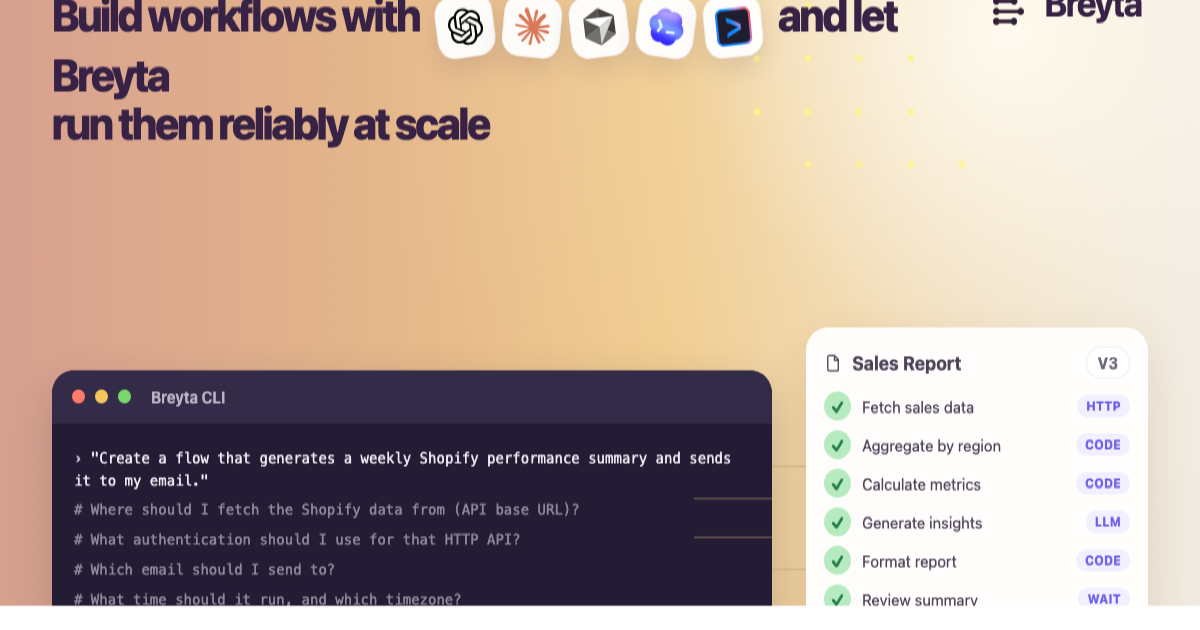
Breyta is a workflow and agent orchestration platform for coding agents. It helps teams build, run, and publish reliable workflows, agents, and autonomous jobs with deterministic execution, clear run history, versioned flow definitions, approvals, waits, reusable templates, and an agent-first CLI.
What this means for observability in agent workflows
- Step-by-step visibility
Every run has clear history and step outputs you can inspect.
- Long-running agents
Run multi-step and long-running jobs with explicit waits. Orchestrate local agents and VM-backed agents over SSH.
- Human-in-the-loop
Approvals and waits are first class. Pause for confirmation, collect feedback, then continue with stateful flows.
- Resource handling
Use resource references for large outputs so artifacts are accessible without bloating run state.
- Versioned releases
Separate draft and live versions. Test updates safely before rolling out changes.
- Agent-first CLI
A CLI designed for agents to create, run, and inspect flows programmatically.
Where Breyta is a fit
- You need the workflow runtime around your agent, not just logs.
- You run multi-step automations, long-running jobs, or approval-heavy flows and want deterministic execution with clear run history.
- You want to orchestrate local agents and VM-backed agents over SSH.
Use a dedicated observability stack from the tools above for deep tracing, evaluations, and LLM-centric monitoring—and pair it with Breyta to reliably orchestrate the workflows around your coding agents.