What Is Workflow Orchestration? Definition, How It Works, and Examples
By Chris Moen • Published 2026-03-15
Workflow orchestration coordinates automated tasks across systems, people, and agents so work runs in the right order with visibility and control. Learn how it works, why it matters, key features to look for, and where Breyta fits for coding-agent workflows.
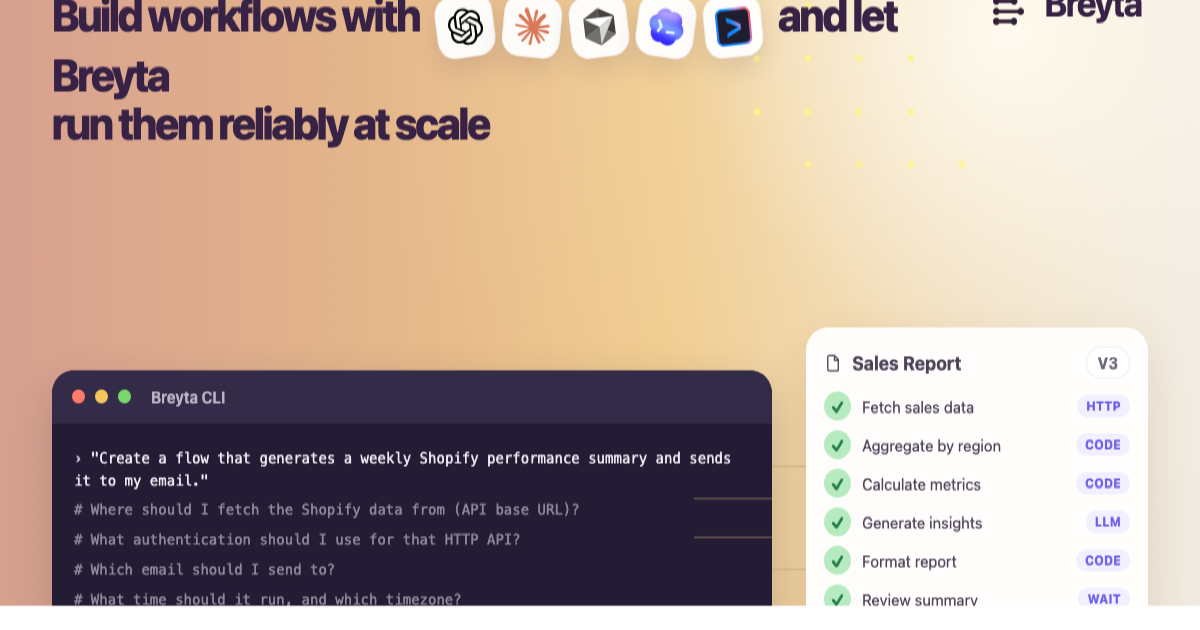
Quick answer: Workflow orchestration is the coordination of automated tasks across systems, people, and agents so each step runs in the right order with clear state, approvals, error handling, and run history.
What is workflow orchestration?
Workflow orchestration manages multi-step work end to end. It connects triggers to tasks, enforces dependencies, carries state between steps, pauses for human decisions, and resumes reliably. The goal is predictable, auditable execution across APIs, services, data, infrastructure, and agents.
How workflow orchestration works
- Triggers start work: schedules, webhooks, events, or manual runs.
- Dependencies and ordering: the orchestrator runs steps in sequence or in parallel based on defined rules.
- State management: inputs, outputs, and decisions persist across steps and restarts.
- Error handling: retries, timeouts, and fallbacks contain failures and surface what happened.
- Human-in-the-loop: the flow can pause for explicit approvals or external callbacks, then resume without losing context.
- Long-running jobs: the system safely waits on external work and picks back up when signals arrive.
- Observability: step-level logs, outputs, and run history make each execution inspectable.
- Versioned changes: definitions move from draft to live so you can evolve workflows without disrupting running work.
How orchestration differs from related terms
Workflow orchestration vs. workflow automation
Automation runs a single task without manual effort. Orchestration coordinates many automated tasks, including ordering, state sharing, approvals, and recovery.
Workflow orchestration vs. scheduling
A scheduler triggers jobs at specific times. An orchestrator adds dependencies, error handling, waits, approvals, and full run history.
Workflow orchestration vs. process orchestration
Process orchestration typically focuses on modeling and optimizing full business processes. Workflow orchestration emphasizes reliable execution of the underlying tasks and integrations that make those processes run.
Workflow orchestration vs. data orchestration
Data orchestration centers on moving and transforming data. Workflow orchestration is broader and also covers APIs, services, agents, infrastructure actions, and human approvals.
Why workflow orchestration matters
- Reliability: deterministic runs, safe retries, and clear history reduce brittle glue code.
- Control: explicit approvals and waits add guardrails for risky steps.
- Speed and scale: parallelization and reusable definitions accelerate delivery.
- Traceability: every step, decision, and output is auditable.
- Fit for long-running work: pause and resume patterns handle remote or VM-backed jobs.
Examples of workflow orchestration
- Order-to-cash: ingest an order, check fraud, bill, fulfill, and notify with approvals for exceptions.
- Customer support: triage a ticket, enrich context, draft a reply, request review, and send on approval.
- Data pipelines: extract, transform, and load data; validate results; alert or roll forward safely.
- Content operations: generate a draft, route for review, and publish after sign-off.
- ML and agent operations: kick off a remote job, wait for a callback, and post results.
- Code operations: open a PR, run checks, wait for human approval, and merge.
For a deeper look at reliability, scale, and observability in agent-driven work, see reliable, scalable, observable agent workflows.
What to look for in a workflow orchestration platform
- Deterministic runtime behavior with clear run history and step outputs.
- Versioned workflow definitions so draft changes never affect live runs.
- First-class approvals and waits for human decisions and external callbacks.
- Support for long-running jobs, including remote or VM-backed execution.
- Flexible triggers (schedule, webhook, manual) and robust error handling.
- Reusable building blocks or templates to standardize common patterns.
- Agent- and CLI-friendly interfaces for teams that build and operate with code.
Getting started
- Map the process: list each step, inputs, outputs, dependencies, and where humans must approve.
- Define triggers and signals: what starts the run, and which events resume a paused flow.
- Design for failure: add retries, timeouts, and compensating actions.
- Version and test: promote changes from draft to live with clear release notes.
- Instrument for visibility: capture step outputs and decisions for auditing.
How Breyta fits
Breyta is a workflow and agent orchestration platform for coding agents. It helps teams build, run, and publish reliable workflows, agents, and autonomous jobs with deterministic execution, clear run history, versioned flow definitions, approvals, waits, reusable templates, and an agent-first CLI.
Breyta is the workflow layer around the coding agent you already use. It is built for multi-step automations, long-running jobs, approval-heavy flows, and agent orchestration. Breyta provides deterministic runtime behavior, explicit approvals and waits, versioned releases, and clear run history, and it can orchestrate local agents and VM-backed agents over SSH.
FAQ
What is the difference between orchestration and automation?
Automation executes a single task without manual work. Orchestration coordinates many automated tasks with ordering, state, approvals, and recovery.
Is a scheduler the same as an orchestrator?
No. A scheduler triggers jobs at set times. An orchestrator manages dependencies, retries, waits, approvals, and run history for end-to-end reliability.
Where do human approvals fit?
Approvals are explicit steps in the flow. Runs pause for review, capture the decision, and resume with state intact to keep risky actions safe and auditable.
When do I need orchestration?
Use it when work spans multiple steps or systems; when jobs are long-running or remote; or when you need human approvals, clear run history, and predictable behavior.
Can workflow orchestration coordinate coding agents?
Yes. Orchestration provides the structure, state, approvals, and recovery around agent tasks. Breyta is designed to be the workflow layer around the coding agent you already use, including local agents and VM-backed agents over SSH.