AI Agent Build Patterns: Reliable execution loops, tooling, and production practices
By Chris Moen • Published 2026-02-26
A practical guide to AI agent build patterns—how to implement execution loops, tool calling, reflection, routing, approvals, and production controls—plus when to use each and how to run them reliably.
AI agent build patterns are the concrete ways you implement and run an agent’s loop: how it plans, calls tools, uses memory, evaluates its own work, and stops. This guide stays focused on execution-time patterns you can ship today, not high-level architecture diagrams.
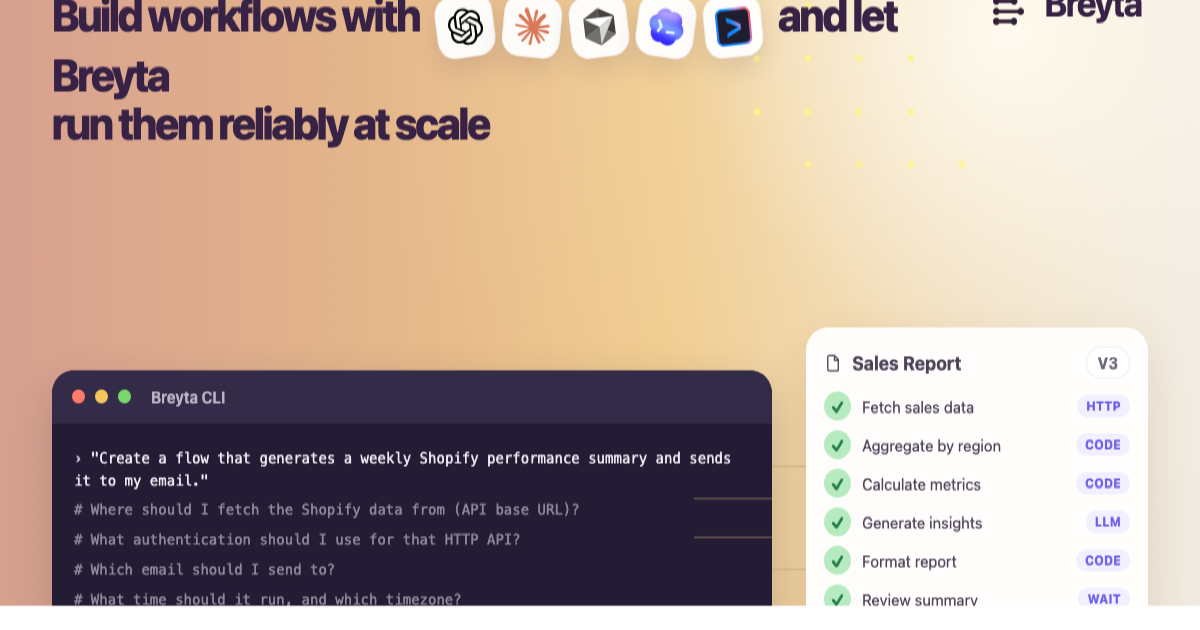
If you need deterministic runtime behavior, explicit approvals and waits, versioned releases, and clear run history for multi-step automations and long-running jobs, consider Breyta, a workflow and agent orchestration platform for coding agents. It is the workflow layer around the coding agent you already use and can orchestrate local agents and VM-backed agents over SSH.
Quick answer: What are AI agent build patterns?
They are implementation templates for reliable agent execution. The most common patterns include:
- Sequential plan-and-execute: generate a plan, then follow it step by step with strict stop conditions.
- ReAct-style tool use: think on a scratchpad, call one tool, observe, repeat within budgets.
- Schema-first function calling: treat every tool call as a typed contract with validation.
- Reflection/verification loops: produce, critique, and repair within bounded retries.
- Router–expert: a classifier delegates to specialized executors with safe fallbacks.
- Supervisor–worker hierarchy: a controller assigns tasks; workers act; a verifier checks.
- RAG-before-act: retrieve authoritative context, then execute a constrained tool flow.
- Parallel fan-out/fan-in: run independent substeps concurrently and reconcile results.
Build vs. architecture: what’s the difference?
Architecture describes components and responsibilities (LLM, tools, memory, orchestrator). Build patterns describe how you actually wire those parts into a dependable execution loop: step order, tool schemas, stop conditions, approvals, waits, retries, and evaluation. Use architecture to choose parts; use build patterns to ship a working agent.
Core execution loop patterns
Sequential plan-and-execute
- When to use: Tasks with clear steps (data transforms, form fills, scripted workflows).
- How it works: Draft a plan, execute each step with a tool call, update state, stop on success/failure.
- Guardrails: Hard caps on steps/time/cost; validate outputs at each boundary.
ReAct-style tool loop
- When to use: Tasks needing short reasoning bursts between tool calls (search, scrape, query, compute).
- How it works: Think → act with one tool → observe → repeat until goal met or budget exhausted.
- Guardrails: One tool per turn, strict schemas, observation sanitization, bounded retries.
Schema-first function calling
- When to use: You must eliminate free-form tool inputs and hallucinated arguments.
- How it works: All tools expose typed JSON schemas; the agent outputs structured calls only.
- Guardrails: Server-side validation, idempotent handlers, least-privilege credentials.
Reflection and verification
- When to use: Quality-sensitive outputs (code changes, financial ops, public content).
- How it works: Produce a draft, run a verifier/critic, apply repairs, and re-verify within a retry budget.
- Guardrails: Separate verifier prompts, deterministic checks, and human approval for high-impact changes.
Router–expert execution
- When to use: Heterogeneous tasks where specialization beats a generalist.
- How it works: A lightweight router classifies the task and dispatches to a constrained expert flow.
- Guardrails: Confidence thresholds, safe default expert, and post-run validation.
Supervisor–worker hierarchy
- When to use: Multi-step projects with role separation and review gates.
- How it works: A supervisor creates a worklist; workers execute tools; a reviewer verifies before publish.
- Guardrails: Explicit stage transitions, approvals/waits, and immutable step logs.
RAG-before-act
- When to use: Tasks requiring grounded facts or policy constraints.
- How it works: Retrieve high-signal context first; feed it into a constrained execution loop.
- Guardrails: Source provenance, freshness checks, and output assertions.
Parallel fan-out/fan-in
- When to use: Independent subtasks that benefit from concurrency (batch lookups, per-file ops).
- How it works: Fan out to parallel workers; fan in with a reconciler to merge, dedupe, and validate.
- Guardrails: Per-branch budgets, partial-failure handling, and deterministic merge rules.
Tooling patterns that reduce error rates
Strict schemas and typed contracts
- Expose tools with explicit JSON schemas and enums; reject free-form strings at the boundary.
- Validate server-side; never trust model-generated arguments without parsing and checks.
Idempotency, retries, and backoff
- Design tools to be idempotent; include request IDs and replay protection.
- Use exponential backoff with jitter; cap retries; record all error contexts.
Side-effect isolation and sandboxes
- Run risky file/code actions in a sandbox with resource limits and audit logs.
- Gate irreversible actions behind approvals and dry-run previews.
Human approvals and waits for high-impact steps
- Insert explicit approvals and waits before actions that change systems or spend money.
- Use versioned flow definitions so approvals match the exact release under execution.
Memory and state patterns
Short-term loop state
- Maintain a structured state object: current plan, step index, budgets, and last observation.
- Summarize frequently to control token use; keep raw traces for auditing.
Long-term facts and assets
- Store reusable facts, embeddings, and files outside the loop; reference by ID in prompts.
- Track provenance and freshness; expire stale entries.
Audit log as a first-class artifact
- Persist an immutable record of tool inputs/outputs, prompts, and decisions.
- Use it for postmortems, regressions, and compliance reviews.
Routing and orchestration patterns
Start with rules, then add LLM routers
- Prefer deterministic heuristics (schema, keywords, scopes) where possible.
- Add LLM-based routing only where rules fail; enforce safe defaults on low confidence.
Cost- and latency-aware dispatch
- Choose model/tool tiers based on budgets; short-circuit easy cases early.
- Emit metrics per route to refine thresholds over time.
Local and remote execution
- Keep lightweight agents local for fast feedback; run heavy workers on VMs.
- Use SSH-based orchestration to execute steps where the resources live and to isolate risk.
Testing and evaluation patterns
Golden tasks and perturbations
- Create stable, labeled tasks; run them on every change to prompts, tools, or models.
- Perturb inputs and instructions to measure robustness and overfitting.
Step-level tracing and metrics
- Trace every tool call, decision, and token budget; correlate failures to specific steps.
- Track success rate, error classes, latency, and cost; alert on drift.
Canaries, A/Bs, and versioned releases
- Roll out changes to a small cohort first; compare against a control.
- Tie evaluations to versioned flow definitions to make results reproducible.
Production controls and budgets
- Define hard caps on steps, time, tokens, and spend; fail closed when exceeded.
- Validate every output against schemas and policy; sanitize untrusted inputs before tool use.
- Use allowlists for egress and resource access; rotate and scope credentials tightly.
- Hand off to a human or a safe generalist when confidence is low.
Common pitfalls and fast fixes
- Vague goals → Add explicit task success criteria and examples.
- Tool sprawl → Remove low-signal tools; narrow scopes and permissions.
- Unbounded loops → Enforce budgets and hard stops; surface partial results.
- Hallucinated calls → Require schema-conformant tool arguments and server-side validation.
- Silent failures → Emit traces, alerts, and clear error classes on every tool error.
- Cost spikes → Cache, summarize, and cap retries; route to cheaper tiers when possible.
Where Breyta fits
Breyta is the workflow layer around the coding agent you already use. It helps teams build, run, and publish reliable workflows, agents, and autonomous jobs with deterministic execution, clear run history, versioned flow definitions, approvals, waits, reusable templates, and an agent-first CLI. Breyta can orchestrate local agents and VM-backed agents over SSH, which is useful for long-running jobs, approval-heavy flows, and multi-step agent orchestration.
FAQ
How many tools should an agent have?
Start with the minimum to solve the task end to end—often one or two tools. Add more only when you see repeated unmet needs in traces.
Do I need multi-agent systems to get value?
No. Many use cases work well with a single agent and a clear loop. Use multi-agent patterns when you need role separation, parallelism, or strong failure isolation.
How do I prevent prompt injection?
Sanitize inputs, restrict tool scopes, and validate outputs. Avoid passing raw user text to sensitive tools without filtering and policy checks.
What metrics matter most?
Task success, error types, latency, and cost. Tie these to step-level traces so you can attribute regressions to specific tools, prompts, or routes.
How do I reduce hallucinations?
Favor retrieval and tool outputs over model guesses, provide precise instructions, and enforce schema validation and verifier checks before publish.