Breyta, Make, Pipedream: Choosing Your n8n Alternative
By Chris Moen • Published 2026-04-27
Compare Breyta, Make, and Pipedream as n8n alternatives. This guide helps developers choose the best workflow automation tool for their specific needs, from agent orchestration to visual and code-first platforms.
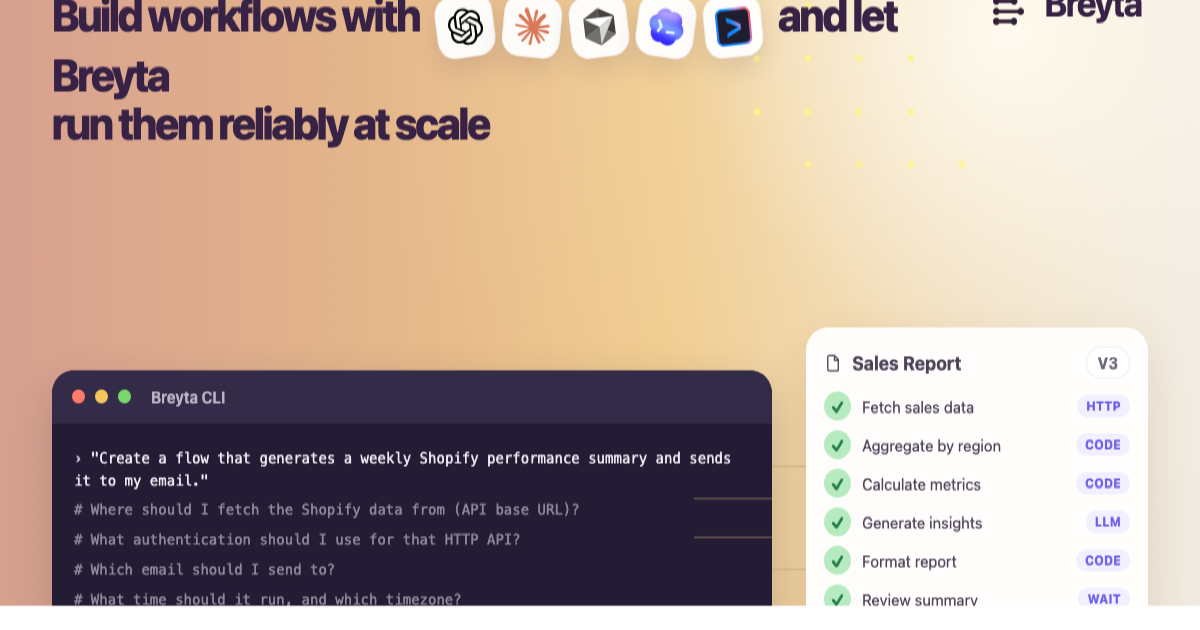
Disclosure: Breyta is our product
If you are looking for n8n alternatives, start with Breyta, Make, and Pipedream. Each serves developers well, but in different ways. This guide gives quick picks, concrete examples, and clear selection criteria.
Quick answer
- Pick Breyta if you need reliable, versioned workflows around coding agents. It fits long-running jobs, VM-backed agents, waits, and approvals.
- Pick Make if you want a visual builder for app-to-app automations that non-devs can help operate.
- Pick Pipedream if you prefer code-first steps in a cloud runtime without managing servers.
At a glance: Breyta vs Make vs Pipedream
| Tool | Best for devs who... | Builder style | Hosting model | Example workflow |
|---|---|---|---|---|
| Breyta | Orchestrate coding agents with deterministic runs, approvals, and long waits | Versioned flows with CLI and explicit steps | Managed workflow runtime. Bring external APIs, local agents, or VMs when needed | Kick off a code agent on a VM over SSH, wait for callback, request human approval, then promote a release |
| Make | Need a visual canvas to move data across many SaaS apps | Visual scenarios with drag and drop | Cloud SaaS | Sync records across apps, branch on conditions, and notify a channel |
| Pipedream | Want to write code inline and wire APIs fast | Code-first steps and triggers | Cloud SaaS | Receive a webhook, transform JSON in code, call multiple APIs in sequence |
What should teams look for?
- Reliability and release control
- Versioned flows. Draft vs live. Clear run history. Safe rollout.
- Long-running and agent-heavy work
- VM and local agent orchestration. Waits. External callbacks.
- Human-in-the-loop
- Built-in approvals. Notifications. Resume with state intact.
- Developer surface
- CLI that returns stable JSON. Inspectable artifacts. Scriptable flows.
- Handling large outputs
- Resource references, not giant inline blobs. Inspect after the run.
- Secrets and connections
- Connect accounts once. Keep workflow logic separate from secrets.
- Triggers and primitives
- Manual, schedule, and webhook/event triggers. HTTP, search, DB, SSH, and more.
Breyta for developers leaving n8n
Breyta is a workflow and agent orchestration platform for coding agents. It helps teams build, run, and publish reliable workflows, agents, and autonomous jobs. You get deterministic execution, clear run history, approvals and waits, versioned releases, and an agent-first CLI.
What this means in practice:
- Model your work as a versioned flow with a stable slug and explicit steps.
- Iterate in draft. Inspect step outputs. Promote to live when ready.
- Call remote agents over SSH, pause with a wait, and resume on callback.
- Keep humans in the loop with approvals and notifications.
- Treat large outputs as resources with compact res:// refs.
Key primitives you can rely on:
- Triggers: manual, schedule, webhook/event
- Steps: http, llm, search, db, wait, function, notify, kv, sleep, ssh
- State tools: approvals, waits, run history, resource persistence
- CLI: agent-first commands, stable JSON, scripts and skills
Concrete workflow examples Breyta supports:
- Autonomous code improvement on a VM. Kick off a detached worker over SSH. Wait for callback. Return a review-ready PR payload. Request approval before apply.
- Support agent on a VM. Answer queries and renew Gmail watch subscriptions. Keep a clear run history.
- Local coding-agent runs. Hand work to a local runner with a wait. Resume the flow on completion.
Operational control that helps in production:
- Versioned flows with draft vs live split
- Immutable releases and explicit promotion
- Configuration checks before release
- Runs are pinned to the resolved release at start time
Security and credentials:
- Connect accounts once
- Secrets stored securely
- Workflows reference connections, not raw credentials
Packaging and reuse:
- Build internal flows
- Package flows as templates or published apps
- Sell mini-app style workflows if you need distribution
Pricing and packaging facts that are safe to note:
- Unlimited users
- Unlimited workflows
- Unlimited steps per flow
- Unlimited concurrent executions
- Billing based on monthly step executions
- Run history retention varies by plan
- Triggers, waits, and approval steps are not billable step executions
When Breyta fits best:
- You already use a coding agent and need a reliable workflow layer around it.
- You run long jobs, VM-backed agents, or approval-heavy flows.
- You want clear structure, state, and release control rather than ad hoc scripts.
Make as a visual alternative
Make is a visual automation platform. It is strong when teams want a canvas to connect SaaS apps and move data with branching logic. Non-dev teammates can follow and help maintain scenarios.
Good fits:
- App-to-app syncs and notifications
- Light data transformations across tools
- Workflows that benefit from a visual map
Example scenario:
- New form submission
- Enrich with another API
- Create a record in a CRM
- Post summary to a channel
Why developers pick it:
- Fast visual assembly
- Broad app connectors
- Easier handoff to non-devs
Pipedream as a code-first alternative
Pipedream is a cloud platform for building workflows with code and prebuilt triggers. You write code in steps, wire APIs, and ship without managing servers.
Good fits:
- Webhook-driven logic in JavaScript or similar
- API integrations with custom transforms
- Event handling and quick automations
Example scenario:
- Stripe event received
- Run a code step to map fields
- Call internal and external APIs
- Log a result and continue
Why developers pick it:
- Code-first ergonomics
- Quick path from event to working API logic
- No server management
How to decide
Choose based on your core shape of work:
- Need agent orchestration, long waits, and approvals
- Pick Breyta. It runs reliable, versioned flows around coding agents. It supports local and VM agents with waits and callbacks.
- Want a visual canvas for SaaS-to-SaaS workflows
- Pick Make. It suits teams that share automation ownership with non-devs.
- Prefer code in the browser with a managed runtime
- Pick Pipedream. It fits developers who want to write logic inline and move fast.
FAQ
What does “alternative to n8n” mean in practice?
You want the same outcome. Build and run automations across apps and APIs. You differ on how you express logic, how you run it, and what operational controls you need.
Why does this matter for production workflows?
Production needs reliability and clarity. Versioned releases, run history, approvals, waits, and safe rollout help you avoid brittle scripts. They also help teams inspect and improve flows over time.