Agent Ops Readiness: A Practical Playbook for Scale, Observability, and Incident Response
By Chris Moen • Published 2026-02-27
Agent ops readiness means your AI agents can scale with control. This practical guide gives a quick answer, checklists for workflow design, observability, and incident response—plus metrics, rollout tips, and a minimal starter stack.
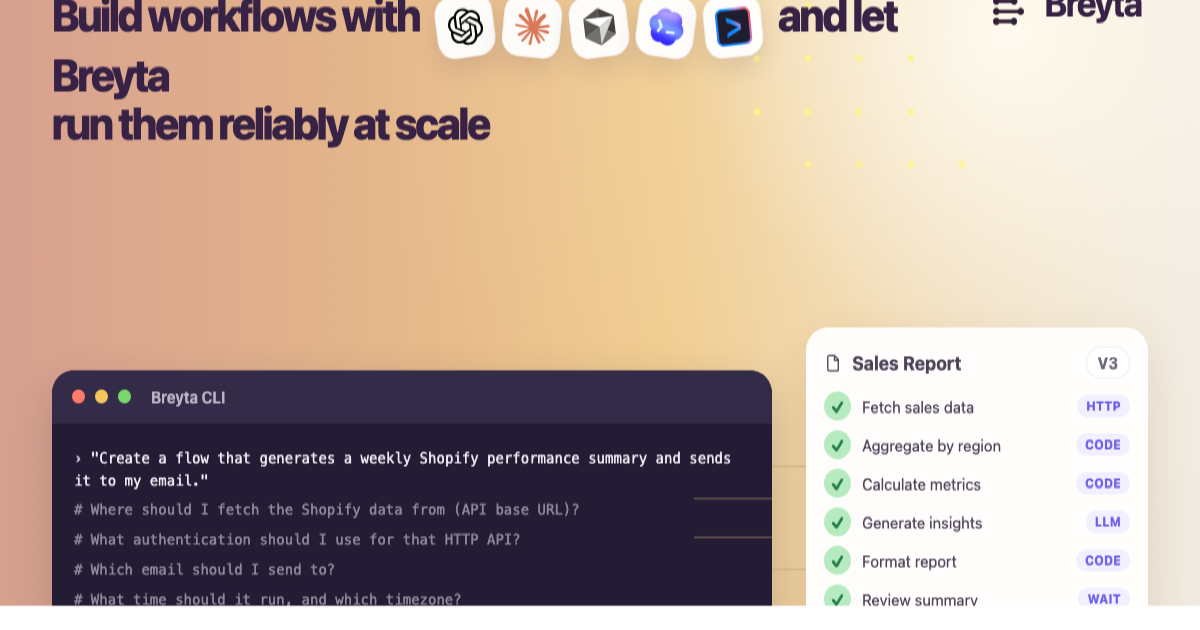
Agent ops readiness is the difference between promising agent demos and dependable production outcomes. Use this practical playbook to get your workflows, observability, and incident response ready for scale—then iterate safely.
Quick answer: What is agent ops readiness?
Agent ops readiness is the state where your agent workflows, telemetry, and incident response can handle growth, change, and failure without losing control of quality, cost, or safety.
- Clear, versioned workflows with explicit steps, approvals, and safe retries
- End-to-end observability across prompts, tools, costs, outcomes, and safety signals
- Defined incident response: severities, on-call, runbooks, and fast rollback
- Safe rollout practices: shadowing, canaries, feature flags, and kill switches
Note: Breyta is a workflow and agent orchestration platform for coding agents. It helps teams build, run, and publish reliable workflows, agents, and autonomous jobs with deterministic execution, clear run history, versioned flow definitions, approvals, waits, reusable templates, and an agent-first CLI. Breyta can orchestrate local agents and VM-backed agents over SSH. Learn more on the Breyta site and find more practical guidance on the Breyta blog.
Why agent ops readiness matters at scale
Scale multiplies failure modes and cost risk. A readiness posture preserves reliability and speed as complexity grows, and supports compliance and audits.
- Protect user outcomes and trust
- Control costs and respect rate limits
- Respond quickly to incidents with clear severity and escalation
Design agent workflows for scale
Keep flows explicit and resilient. Break work into steps with owners and guardrails. Add human checkpoints where stakes are high.
- Map tasks, roles, and handoffs; maintain a RACI
- Use a state machine or durable workflow; make steps idempotent
- Add timeouts, retries with jitter, and backoff
- Queue work; apply backpressure at rate limits
- Tiered triage; escalate by skill and risk
- Human-in-the-loop approvals for sensitive actions
- Document SOPs; train and test changes with users
Workflow design essentials
- Clear entry and exit for each step
- Idempotent operations and safe retries
- Queues, timeouts, and circuit breakers
- Human review gates for sensitive paths
Observability for AI agents
Capture what the agent did, why it did it, what it cost, and how users were affected. Alert on user impact, not just infrastructure noise.
- Correlation IDs per request and per agent run
- Structured logs: prompts, model, version, tool calls, and results (redact secrets and PII)
- Metrics: success/error rate, latency, token and cost per task, tool failure rate
- Distributed traces across services and tools; include step names and spans
- Label outcomes and safety events: policy violations and overrides
- Set SLOs for key flows; page on SLO burn or saturation
- Version prompts and configurations; record diffs
- Canary and shadow changes; compare before full rollout
Signals to alert on
- Drop in task success or spike in hallucination/safety flags
- Tool error spikes or timeouts
- Cost or token surges per task
- Latency regressions and queue backlogs
Run readiness tests and reviews
Prove readiness before stakes are high. Use checklists, dry runs, and game days; fix and retest.
- Production readiness checklist with centralized criteria
- Load, failure, and data validation tests
- Iterative readiness tests tied to meaningful changes
- Shadow live traffic; compare outputs to baselines
- Train and certify operators; confirm on-call coverage
- Review comms plans and escalation paths
Prepare incident response for agents
Plan for model, tool, data, and policy failures. Define roles, severities, and runbooks. Practice regularly.
- Severity matrix and triage flow
- On-call rotation and paging rules
- Runbooks for common faults with rollback steps
- Kill switch and traffic shaping; fail closed for risky actions
- Fallbacks: safer models or cached answers when appropriate
- Evidence preservation: keep logs and traces for postmortems
- Blameless reviews; update SOPs and tests
Common agent incident types
- Hallucinations or unsafe content
- Tool unavailability or degraded APIs
- Data drift or stale knowledge
- Prompt regressions after a change
- Cost spikes or rate limit exhaustion
Day-to-day controls that reduce agent risk
Use simple, layered controls. Automate wherever feasible.
- Input and output validation; guardrails and filters
- Policy checks before action; approvals for high-risk steps
- Least privilege for tools and data
- Quotas per user and per agent; stop runaway loops
- Feature flags for prompts, tools, and models
- Change windows and rollout plans
Measure success for agent ops
Tie metrics to user value across reliability, quality, speed, and cost.
- Task success rate and assisted resolution rate
- Escalation and human handoff rate
- Mean time to detect (MTTD) and resolve (MTTR)
- Latency per step and end-to-end
- Cost per successful task
- Tool error and timeout rates
- Safety flags and policy override counts
Roll out agent changes safely
Ship in small, reversible steps. Watch user impact in near real time.
- Feature flags and config versioning
- Shadow new prompts or models; compare outputs
- Canary to a small slice; expand by health checks
- Fast rollback buttons; revert on regressions
- Communicate changes; update SOPs and training
Minimal starter stack
Keep the stack simple and observable; add depth as you scale.
- Orchestrator or workflow engine with durable state
- Job queue and scheduler
- HTTP client with retries, timeouts, and circuit breakers
- Structured logging, metrics, and tracing
- Secrets and config management with versioning
- Feature flag service and kill switch
- Data redaction and access control
- Dashboard for SLOs and alerts
FAQ
How often should I run readiness tests?
Run them before launch, then on each meaningful change. Schedule regular game days to validate failure handling and on-call practices.
What is the fastest way to add observability?
Start with structured logs and correlation IDs, add key metrics and a simple dashboard, then layer in tracing for cross-service visibility.
Do I need humans in the loop for every agent?
No. Use human review for high-risk steps and automate low-risk, repeatable work. Make review gates explicit and auditable.
How do I control agent costs?
Set quotas and budgets per agent and per user. Monitor token and cost per task. Alert on surges and tie dashboards to SLOs.
What should trigger a kill switch?
Unsafe outputs, data leak risk, severe tool failures, runaway costs, or critical SLO breaches. Failing closed is safer for high-risk paths.