Workflow Tools for Developers: A Comprehensive Comparison
By Chris Moen • Published 2026-03-31
Choose the right workflow tool for your development needs. This guide compares Temporal, Airflow, Dagster, and Breyta for microservices, data pipelines, data platforms, and agent-driven automations.
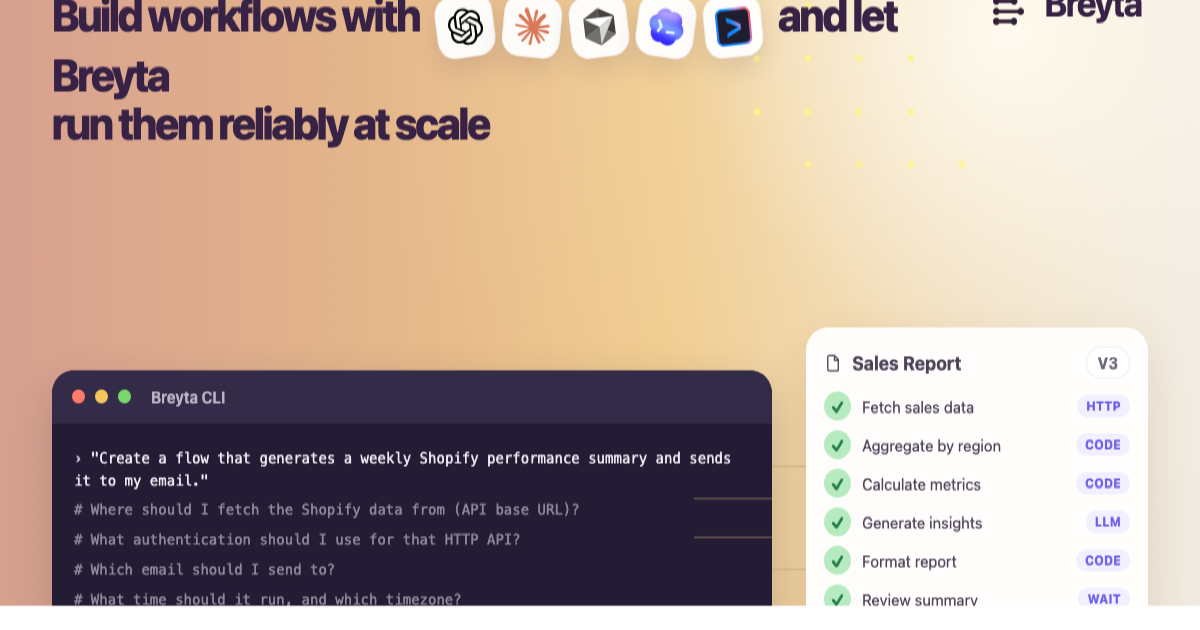
Quick answer
The best tool depends on your workload. Pick Temporal for durable microservice orchestration. Use Airflow for batch data pipelines. Choose Dagster for data platforms and asset lineage. Use Breyta when you need agent workflows, long-running jobs, approvals, and versioned releases.
Disclosure: Breyta is our product
- If you run service workflows with strict SLAs and durable state: Temporal
- If you schedule and monitor ETL and batch analytics: Airflow
- If you build a data platform with assets, lineage, and testing: Dagster
- If you need agent-driven automations with waits, approvals, and VM or local agents: Breyta
Examples
- Temporal: orchestrate payments with retries and timeouts across services
- Airflow: run nightly warehouse loads and downstream reports
- Dagster: manage a lakehouse asset graph with clear lineage
- Breyta: kick off a coding agent on a VM, wait for a callback, request approval, then merge a PR
What “workflow tools for developers” means in practice
You define work as code. The platform runs and tracks it. Good systems give you:
- Clear structure for triggers, steps, and state
- Deterministic runtime behavior
- Retry, timeouts, and visibility into each step
- Versioning and safe release control
- Support for long-running work that may pause and resume
- Separation of secrets from logic
- Logs, run history, and inspectable artifacts
Why it matters for production workflows
Production needs more than a script. You need:
- Reliability at every step
- Traceable runs and outputs
- Safe rollout of changes
- Human-in-the-loop where needed
- Strong handling of long jobs and external systems
- A runtime you do not babysit
Decision criteria
Map your needs first.
- Workload type
- Microservices and stateful business flows
- Batch ETL and analytics
- Asset-centric data platform
- Agent and automation jobs with pauses, approvals, or VMs
- Execution model
- Event-driven vs scheduled
- Short jobs vs long-running work
- Human checkpoints
- Built-in approvals vs app-level logic
- Environment and tools
- Language and SDK needs
- Local or VM agents
- Secrets and connection management
- Operations and control
- Run history and observability
- Versioning and promotion
- Resource handling for large outputs
- Hosting and scale
- Managed vs self-hosted
- Concurrency and state limits
- Pricing shape
- By step, run, or workers
- Retention needs
Comparison at a glance
| Tool | Primary fit | Authoring model | Long-running pattern | Human approvals | Agent orchestration | Typical examples | Infra model summary |
|---|---|---|---|---|---|---|---|
| Temporal | Durable service workflows | Workflows as code | Native durable execution with state | App-level implementation | App-level integration | Payments, provisioning, order lifecycle | Self-managed or managed offerings |
| Airflow | Batch ETL and scheduled data jobs | Python DAGs and operators | Task scheduling with retries | App-level implementation | Not a core focus | Nightly warehouse loads, report pipelines | Self-managed or managed offerings |
| Dagster | Asset-centric data platforms | Python, software-defined assets | Orchestrated runs across assets | App-level implementation | Not a core focus | Lakehouse assets, lineage-aware pipelines | Self-managed or managed offerings |
| Breyta | Agent and automation workflows with control | Versioned flow definition | Remote or local agent pattern with waits | Built-in approvals and waits | Built-in orchestration layer | VM-backed agents, review-and-apply, sync jobs | Breyta handles orchestration runtime |
Temporal
What it is
- A system for durable, stateful workflows as code.
- Strong fit for microservice orchestration and transactional flows.
Strengths
- Durable execution and state tracking within workflows.
- Good for retries, timeouts, and precise control.
- Event-driven service logic with clear semantics.
Where it shines
- Payments and order pipelines
- Provisioning and lifecycle workflows
- Coordinating services with strict SLAs
Trade-offs
- App-centric model shifts more logic into code.
- Human approvals and UI flows live in your app layer.
- Best for service orchestration instead of classic batch ETL.
Apache Airflow
What it is
- A scheduler and orchestrator for batch workflows.
- DAGs in Python with a large set of operators.
Strengths
- Strong for ETL and analytics pipelines.
- Clear scheduling and dependency handling.
- Broad ecosystem of integrations.
Where it shines
- Nightly warehouse loads
- Backfills and scheduled reporting
- Periodic data exports and syncs
Trade-offs
- Event-driven microservice use is not the core focus.
- Long-lived tasks often need external handling.
- Human approvals require custom logic.
Dagster
What it is
- A data orchestrator with an assets-first model.
- Emphasizes lineage, testing, and data-centric design.
Strengths
- Software-defined assets and asset graphs.
- Strong structure for IO and testing.
- Good visibility into data dependencies.
Where it shines
- Lakehouse and analytics platforms
- Asset lineage and quality gates
- Team workflows around data products
Trade-offs
- Best for data platforms, not generic service orchestration.
- Human approvals and agent patterns require custom code.
Breyta
What it is
- Breyta is a workflow and agent orchestration platform for coding agents.
- It helps teams build, run, and publish reliable workflows, agents, and autonomous jobs with deterministic execution, run history, versioned releases, approvals, waits, and an agent-first CLI.
How it works
- Flows are versioned definitions with triggers, steps, approvals, waits, and a clear concurrency policy.
- You push draft changes, test, inspect outputs, then release to a stable live target.
- Triggers include manual, schedule, and webhook or event.
- Step families include http, llm, search, db, wait, function, notify, kv, sleep, and ssh.
Long-running and agents
- Breyta supports a remote-agent pattern. Start work on a VM over SSH, pause with wait, then resume when the agent posts back to a callback URL.
- It also supports local-agent runs that pause and resume the flow.
- This makes VM-backed or local coding-agent jobs reliable without keeping a session open.
Approvals and human-in-the-loop
- Approvals and waits are first-class.
- Flows can pause for human review and resume later with state intact.
Resources and large outputs
- Use persist to store large artifacts.
- Steps pass compact resource refs so runs stay lean and inspectable.
CLI and agent-first operation
- The CLI returns stable JSON for agents to parse.
- You can install skills that teach agents how to author and operate flows.
Release control
- Draft vs live is explicit.
- Releases are versioned and immutable.
- Runs are pinned to the resolved release at start time.
Use cases
- Support automation and billing sync
- Code operations and autonomous code improvement
- VM-backed content operators with approvals
- Published apps and reusable templates
Security and credentials
- Connect accounts once and store secrets securely.
- Workflows reference connections, not raw credentials.
Infrastructure and operations
- Breyta handles execution, state, retries, and recovery for the orchestration layer.
- You can still bring VMs, SSH targets, and external APIs as needed.
Pricing shape
- Unlimited users
- Unlimited workflows
- Unlimited steps per flow
- Unlimited concurrent executions
- Billing based on monthly step executions
- Run history retention varies by plan
- Triggers, waits, and approval steps are not billable step executions
Which should you pick?
Start with your dominant need.
- Service orchestration with durable state: Temporal
- Batch ETL and analytics at scale: Airflow
- Data platform with assets and lineage: Dagster
- Agent-driven automations, long-running jobs, approvals, and VM or local agents: Breyta
Mixed environments are common.
- Use Temporal for service flows and Airflow or Dagster for data jobs.
- Add Breyta when you need agent workflows with pauses, SSH to VMs, and built-in approvals and release control.
Examples by scenario
- Product engineering
- Temporal for order lifecycle and provisioning
- Breyta to run a coding agent on a VM, wait for a callback, request approval, then create a PR
- Data team
- Airflow for scheduled ingest and backfills
- Dagster for asset lineage, tests, and downstream refresh
- Ops automation
- Airflow for nightly syncs
- Breyta for approval-heavy changes and reusable mini-app style workflows
FAQ
Can I combine these tools?
Yes. Many teams do. Use each for its strength. Keep workflows scoped and observable.
When do I need built-in approvals?
Use built-in approvals when changes must pause for review. Breyta supports approvals and waits as core features.
What if my jobs run overnight?
Pick a tool with a clear long-running pattern. Temporal and Breyta both handle long-running workflows with state and resume behavior. Airflow and Dagster can run long tasks, but long-lived patterns often need extra handling at the task level.