Workflow Observability: Tracing, Evaluating, and Controlling Costs for AI Agents
By Chris Moen • Published 2026-04-22
Discover the best workflow observability tools for AI agents in 2026. Learn how to trace multi-step runs, evaluate quality, and control costs with Breyta, LangSmith, Langfuse, and more.
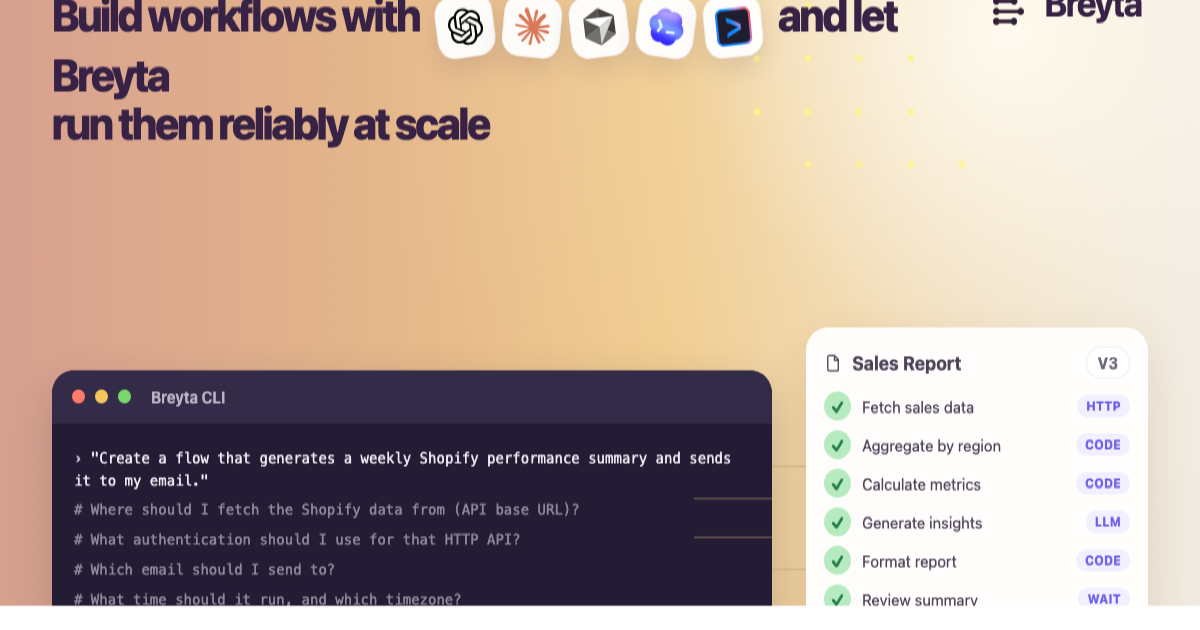
Disclosure: Breyta is our product
The best workflow observability tools for agent workflows help you trace multi-step runs, evaluate quality, and control cost. Strong picks in 2026 include Braintrust, LangSmith, Langfuse, Arize Phoenix, Helicone, Galileo, Azure AI Foundry Observability, and workflow runtimes like Breyta for step-level history and approvals.
Quick picks
- Braintrust: Evaluation-first traces and production feedback loops. See the Braintrust comparison of tools for 2026.
- Helicone: Proxy-based setup with multi-provider cost controls noted in the same Braintrust guide.
- Galileo: Agent reliability with fast evaluators for safety checks, as described by Braintrust and this Galileo roundup.
- LangSmith: Listed among 2026 LLM observability tools in this Medium guide and other roundups.
- Langfuse: Open source and self-host friendly, per this developer comparison.
- Arize Phoenix: Also open source and self-host oriented in that developer comparison.
- Azure AI Foundry Observability: Unified governance, evaluation, tracing, and monitoring per Microsoft’s Azure blog.
- Breyta: A workflow and agent orchestration platform for coding agents. It gives deterministic execution, clear run history, approvals, waits, and versioned releases.
What “workflow observability” means in practice
You need to see how an agent completes a job across steps, tools, and systems.
Core parts:
- Traces. Follow the path from trigger to finish. Include tool calls and timings.
- Logs. Capture prompts, responses, inputs, outputs, and errors.
- Metrics. Track latency, error rate, and spend per run.
- Evals. Score outputs against checks for quality or safety.
- State and checkpoints. Pause and resume with human approvals or external callbacks.
- Artifacts. Store large outputs outside step state with inspectable references.
Many 2026 observability roundups focus on agent traces, evaluation, and production feedback loops. See the Braintrust overview of agent observability platforms for context.
Why it matters for production workflows
- Root-cause analysis. You need the exact step that failed and why.
- Reliability. Catch regressions before they hit users with evaluations and monitors.
- Cost control. See where tokens, time, or compute go.
- Safety and governance. Add checkpoints around risky actions.
- Long-running jobs. Keep state while external workers do heavy work, then resume with context.
Microsoft highlights observability as key to effective, transparent, and safe AI in its Azure AI Foundry Observability post.
What to look for
Fit your stack and risk profile first.
- Tracing scope
- In-agent traces that capture prompts, tools, and decisions
- Workflow runtime traces that add step state, approvals, and retries
- Evals and testing
- Automated scoring and regressions on real traffic
- Blocking checks for safety or policy
- Cost and performance
- Token and API spend per step or tool
- Latency and error budgets
- Long-running and human-in-the-loop
- Waits, callbacks, and approvals with full run history
- Hosting and compliance
- Open source and self-host vs managed SaaS vs cloud-provider native
- Integration surface
- SDKs, proxies, webhooks, and export of runs and artifacts
- Secrets and connections
- Clear separation of workflow logic from credentials
- Versioning and rollout
- Draft vs live, immutable releases, and run pining
Top tools and where they fit
- Braintrust
- What it is: An evaluation-first platform with comprehensive trace capture, automated scoring, real-time monitoring, and production feedback loops, per the Braintrust guide.
- When to use it: You want strong evals and deep traces across agent reasoning and tool use.
- Helicone
- What it is: Proxy-based observability with multi-provider cost optimization noted in the Braintrust roundup.
- When to use it: You want quick drop-in tracing and cost controls without deep code changes.
- Galileo
- What it is: An agent reliability platform with fast, cost-effective evaluators for production safety checks, as described in the Braintrust piece and this Galileo comparison.
- When to use it: You need scalable evaluators on live traffic.
- LangSmith
- What it is: Listed among top LLM observability tools in this Medium guide and other 2026 roundups.
- When to use it: You want a managed tracing and evaluation stack recognized across agent tooling lists.
- Langfuse
- What it is: Open source and self-host friendly per this developer-focused comparison.
- When to use it: You need full control and hosting on your infra.
- Arize Phoenix
- What it is: Also open source and viable for self-hosting per the same developer comparison.
- When to use it: You prefer open tooling with flexible deployment.
- Azure AI Foundry Observability
- What it is: A unified solution for agent governance, evaluation, tracing, and monitoring, according to Microsoft’s blog.
- When to use it: You build in Azure and want native governance and monitoring.
- AgentOps
- What it is: Named among agent observability tools in a 2026 overview on AI Multiple.
- When to use it: You want options focused on agentic monitoring and are surveying the space.
- Maxim AI
- What it is: Included among RAG and agentic observability platforms in Maxim’s RAG tools guide.
- When to use it: You run RAG-heavy pipelines and want targeted tracing and checks.
- Breyta
- What it is: A workflow and agent orchestration platform for coding agents. It helps teams build, run, and publish reliable workflows, agents, and autonomous jobs with deterministic execution, clear run history, versioned releases, approvals, waits, reusable templates, and an agent-first CLI.
- Observability angle: Breyta gives step-by-step run history and outputs. It supports approvals and waits as first-class steps. It treats large outputs as persisted resources with inspectable refs. The CLI returns stable JSON so agents and operators can parse runs and artifacts.
- Long-running agents: Breyta supports a remote-agent pattern. You can kick off work on a VM over SSH, pause the workflow with a wait step, then resume when the worker posts back to a callback URL. This keeps state without holding a fragile long-lived connection.
- Where it fits: You want operational visibility tied to workflow structure. You need human-in-the-loop control. You run local agents or VM-backed agents and want reliable orchestration around them. Bring your coding agent. Use Breyta as the workflow layer around it.
How Breyta fits this use case
Breyta is built for multi-step workflows with state, approvals, and agents. You describe the job, run drafts, inspect step outputs, then promote a versioned flow to live. Runs are deterministic and pinned to the resolved release.
Why teams use Breyta for observability around agents:
- Clear run history with step outputs
- Deterministic execution and retries at the workflow layer
- Approvals and waits that pause and resume with state intact
- Resource refs that keep large artifacts inspectable without bloating state
- Orchestration of local and VM-backed agents over SSH
- An agent-first CLI that returns stable JSON for scripting and inspection
Common patterns include:
- Local coding-agent execution with waits
- VM-backed agents that post results later through callbacks
- Approval-heavy flows that verify and apply changes only after review
- Content operators that generate drafts, request approval, and publish on approval
Breyta is not a coding model. It does not replace your agent. It is the workflow layer that makes long-running or approval-heavy agent work reliable and inspectable.
FAQ
Do I need both a workflow runtime and an observability platform?
Often yes. Use a workflow runtime for structure, state, approvals, waits, SSH orchestration, and releases. Pair it with an observability platform for traces, evals, and cost analytics inside the agent’s reasoning and tool calls. Breyta covers the workflow side with clear run history and step outputs. You can still log or trace within your agent code as needed.
How do I handle long-running agent jobs without losing visibility?
Use a runtime that supports waits and callbacks with persisted state. In Breyta, the flow can start remote work over SSH, pause with a wait step, and resume on callback. You keep a single run history across the whole job.
Where should I store large artifacts from agent runs?
Prefer a resource model. In Breyta, you can persist large outputs and pass compact refs between steps. This keeps runs inspectable without pushing large blobs through every step.