What is vibe marketing?
By Chris Moen • Published 2026-07-21
Vibe marketing applies the vibe coding pattern to marketing: describe the goal and brand, let AI agents produce and ship the work, and direct instead of doing each task.
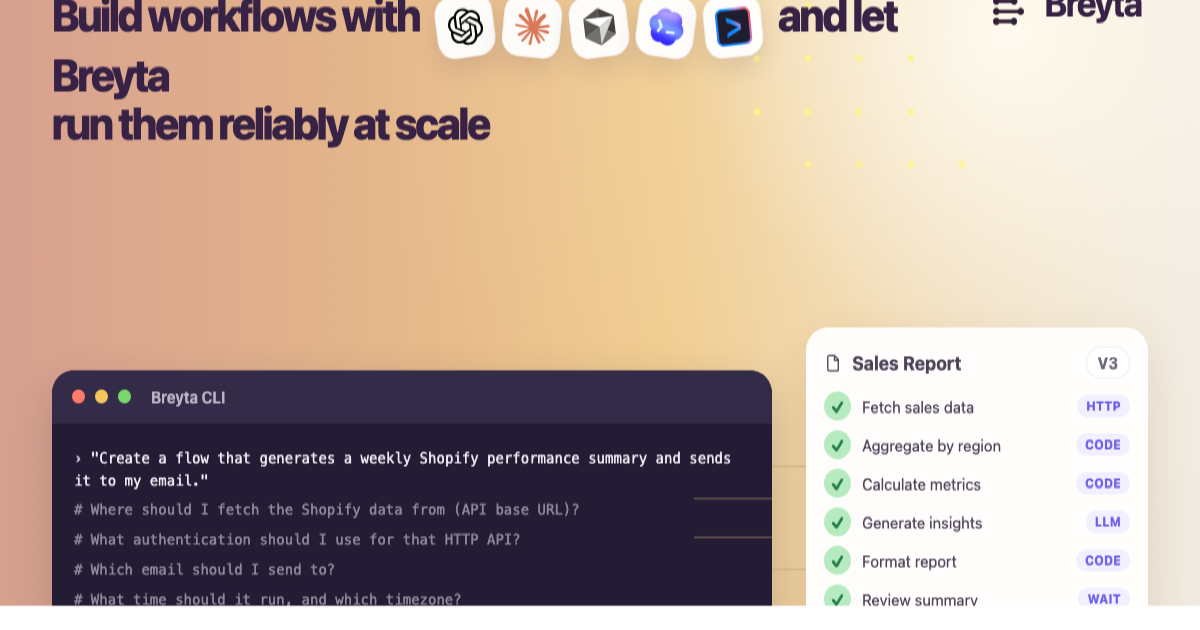
Vibe marketing is running marketing the way vibe coding runs software: one person describes the goal and the brand, and AI agents produce and ship the content, campaigns, and channel work, while the human directs and sets the rules instead of doing each task by hand. It grew from vibe coding and spread through founder communities in 2025 and 2026.
Where did vibe marketing come from?
Vibe marketing came from vibe coding, the 2025 idea that you describe what you want and let AI build it. Marketers borrowed the pattern.
The parallel is simple once you see it. In vibe coding, a developer writes a plain-language prompt and an AI agent writes the code. In vibe marketing, a founder describes the product, the audience, and the brand, and AI agents write the blog posts, draft the social, and run the channel work. The person moves from doing the tasks to directing them. It caught on fastest with the people who have a product to sell and no marketing hire. For them, vibe marketing is simply how marketing gets done at all.
- The vibe coding parallel: a developer writes a plain-language prompt and an AI agent writes the code; vibe marketing applies that same pattern to campaigns and content
- The timing: Andrej Karpathy coined vibe coding in early 2025, entrepreneur Greg Isenberg popularized the vibe marketing label soon after, and it spread through founder communities into 2026
- Who adopts it: solo founders and small teams who have a product to sell but no marketing hire
- The shift for the human: you stop producing each asset and start directing agents and setting the rules they follow
How is vibe marketing different from traditional marketing?
Traditional marketing splits work across specialists and calendars. Vibe marketing collapses that into one person directing agents, which changes who does the work, how fast it moves, and where the risk sits.
The tradeoff runs in both directions. Traditional marketing operations rely on writers, designers, media buyers, and a manager coordinating them. Vibe marketing puts a founder at the center with AI agents doing the production. You gain speed and lower cost, and you take on new risks around brand consistency and accuracy. The risk that changes most: mistakes now repeat across every channel at once instead of costing one post.
| Dimension | Traditional marketing ops | Vibe marketing |
|---|---|---|
| Who does the work | Specialists (writer, designer, buyer) plus a manager | One person directing AI agents |
| Speed | Days to weeks per asset | Minutes to hours per asset |
| Cost | Salaries, agencies, or retainers | Software plus your time |
| Where the human spends time | Producing each deliverable | Setting positioning and rules, reviewing output |
| Main risk | Slow output, high fixed cost | Brand drift and generic output at scale |
What does a vibe marketing workflow look like?
A vibe marketing workflow runs in five steps: set the brand, feed source material, generate across channels, set publishing rules, then monitor and correct.
Here are the five steps most teams follow:
- Set positioning and voice by writing down who you serve, what you sell, and how you sound, so every agent works from the same brief. A usable voice lock is three lines: who it is for, the one promise you make, and three tone rules like "plain words, concrete nouns, no hype"
- Point agents at source material like your website, product docs, and past posts, which gives the output real facts instead of guesses
- Generate across channels so one input becomes a blog post, several social posts, and an email, keeping the message consistent
- Set rules for what ships automatically and what needs review, keeping a human approval step for brand-sensitive or high-stakes actions
- Monitor and correct by watching what published, what performed, and where the voice slipped, then tightening the brief
The setup steps are where quality is won or lost. A vague brief in step one produces bland output in step three, no matter how good the agent is.
What are the risks of vibe marketing?
The main risk of vibe marketing is scale: mistakes that used to cost one post now repeat across every channel at once. The failures cluster into a few types.
- Brand drift, where the voice slowly wanders off target across dozens of posts until the account no longer sounds like you
- Generic AI slop that readers distrust, since audiences increasingly recognize formulaic AI writing and trust it less
- Off-brand or inaccurate claims that ship because no one checked a specific number, a product detail, or a comparison before it went live
- Over-automation of relationship channels like founder replies and community threads, where the personal touch is the entire point and automation reads as cold
- Compounding errors, because a wrong fact in your source brief gets repeated by every agent that reads it
This is the honest edge of vibe marketing: it fails the same way vibe coding fails. It's cheap to produce and expensive to trust. The differentiator isn't generating more content. It's the guardrails, the locked brand voice, and knowing which actions still need a human.
What do you need to do vibe marketing well?
Doing vibe marketing well takes four things: cross-channel execution, a locked brand voice, configurable approval rules, and monitoring.
Most vibe marketing content teaches you to generate faster. The harder part is the trust layer that keeps volume from turning into a liability. Here is what that layer needs:
- Cross-channel execution: an agent that produces and ships work across your channels, not one asset at a time
- A locked brand voice: the voice set once and applied to every asset, so the output holds together across dozens of posts
- Configurable rules and approvals: rules you set yourself, so routine posts go out on a cadence while brand-sensitive actions wait for a human
- Drift monitoring: a way to see what published and how it performed, so a bad run surfaces in hours instead of quietly running for a week
Different tools cover different parts of this. General-purpose AI writers like Jasper and Copy.ai handle the generation but leave the trust layer to you, while founder-focused agents try to package execution and guardrails together. For a side-by-side, see the best AI marketing agents for founders.
Breyta, an AI marketing agent, is one example of that execution-plus-guardrails layer. You point it at your website, and it drafts from what is already there rather than from a blank prompt. It runs content generation, marketing monitoring with alerts, inbound email replies, and paid-ads oversight through one orchestrating agent. You set the rules for what publishes, sends, and spends, and approval gates for sensitive actions are built in so you can keep a human step where brand risk is real. Every run is logged, so you can see exactly what happened, and the same message never goes out twice. The honest catch: Breyta is a platform and marketplace, so your real monthly cost is the base plan (from $29/mo, or $99/mo for the popular Growth tier, which includes 2,000 AI credits a month) plus any paid apps you install, with extra credits if you run heavy. It also favors breadth across channels over single-channel depth. If your whole bottleneck is one thing, like ad creative, a specialist tool will go deeper there.
If you're a team of one, start by picking one channel and one workflow. Our guide on how solo founders can start marketing without doing everything at once walks through that.
FAQ
Is vibe marketing the same as AI marketing?
Not quite. AI marketing is any use of AI in marketing, including a single tool that writes captions. Vibe marketing is a specific style where a person describes the goal and AI agents produce and ship the work across channels, while the human directs and sets rules rather than doing each task.
Does vibe marketing replace marketers?
No. Vibe marketing changes what marketers do rather than removing them. The person shifts from producing every asset to directing agents, setting the brand voice, writing the rules, and reviewing sensitive output. Judgment, positioning, and relationship work still need a human. The production step is what gets automated.
Is vibe marketing just AI slop?
It can be, and that's the risk. Vibe marketing produces slop when the brief is vague, the brand voice isn't locked, and nothing gets reviewed. Done well, with a strong brief, a fixed voice, and human review on brand-sensitive actions, it does not. The guardrails decide the outcome.
What is an example of vibe marketing?
Here is a common one: a solo founder points an AI agent at their website, and the agent turns one product update into a blog post, four social posts, and an email, publishing the routine ones on a schedule while the founder reviews anything customer-facing. One brief, many channels, one person directing.
Key takeaways
- Vibe marketing applies the vibe coding pattern to marketing: you describe the goal and brand, AI agents produce and ship the work, and you direct instead of doing each task
- The term emerged in 2025 from vibe coding and spread through 2026, catching on fastest with solo founders and small teams who have a product to sell and no marketing hire
- Versus traditional marketing, it trades salaries and slow cycles for software plus your time, moving the human from production to positioning and review
- A typical workflow runs in five steps: set voice, feed source material, generate across channels, set publishing rules, then monitor and correct
- The core risk is scale, where brand drift, generic output, and inaccurate claims repeat across every channel at once instead of costing one post
- Doing it well takes cross-channel execution, a locked brand voice, configurable rules and approvals for sensitive actions, and monitoring that catches drift early
Try vibe marketing with guardrails
If you want the execution without the slop, point Breyta at your website and it drafts from what is already there. It runs content, monitoring, inbound replies, and ads oversight through one agent, with approval gates you configure and a full audit trail on every run. Free 14-day trial, no card; then from $29/mo (Growth $99/mo, 2,000 credits included) plus any paid apps you install. See breyta.ai.