Top Workflow Orchestration Tools for Developers in 2026
By Chris Moen • Published 2026-05-08
Explore the leading workflow orchestration tools for developers in 2026, balancing durable execution, clear run history, and first-class code support. Make an informed choice based on your stack, latency needs, and cloud strategy.
Opening answer
You have strong options in 2026. The best developer tools balance durable execution, clear run history, first-class code support, and sane ops. Start with your stack, latency needs, and appetite for cloud lock-in.
Disclosure: Breyta is our product
What workflow orchestration means in practice
- It coordinates multi-step work. Think triggers, steps, waits, approvals, and retries.
- It holds state across time. Runs survive restarts and long waits.
- It tracks runs. You can inspect inputs, outputs, and decisions.
- It separates logic from secrets. Connections live outside your flow code.
- It runs on a schedule, manual trigger, or webhook.
What to look for in 2026
- Durability and state
- Long-running jobs without fragile open connections
- Idempotency, retries, and step-level visibility
- Developer experience
- Code-native authoring, typed SDKs, CLI, JSON output for tooling
- Versioning and a safe draft-to-live release flow
- Agent and human-in-the-loop
- Native waits, approvals, callbacks, and notifications
- Runtime reach
- Local runners, VMs over SSH, webhooks, and API steps
- Event-driven triggers and fan-out support
- Secrets and connections
- Central credential management decoupled from flow code
- Op controls
- Concurrency policies, run history, and resource handling for large outputs
- Fit for your stack
- Cloud-native vs self-host
- AWS-only vs multi-cloud
- TypeScript, Python, or polyglot
Quick picks by scenario
- TypeScript apps that need durable, event-driven jobs
- Trigger.dev or Inngest
- Enterprise-scale durable workflows with strict SLAs
- Temporal
- All-in on AWS with serverless patterns
- AWS Step Functions
- Self-hosted visual automation with code escapes
- n8n
- Quick API automations with code in the loop
- Pipedream
- Data engineering DAGs in Python
- Apache Airflow
- Agent-first workflows with long waits, approvals, and VM or local agents
- Breyta
The 2026 field at a glance
A common shortlist includes n8n, Zapier AI, Make, Pipedream, Trigger.dev, Inngest, Temporal, and AWS Step Functions, as noted in this 2026 roundup by Digital Applied. See their comparison of the eight tools for context on categories and tradeoffs: n8n, Zapier AI, Make, Pipedream, Trigger.dev, Inngest, Temporal, and AWS Step Functions (source: AI Workflow Orchestration Tools 2026: Comparison by Digital Applied).
Below are developer-focused notes and buyer-fit examples.
- Breyta
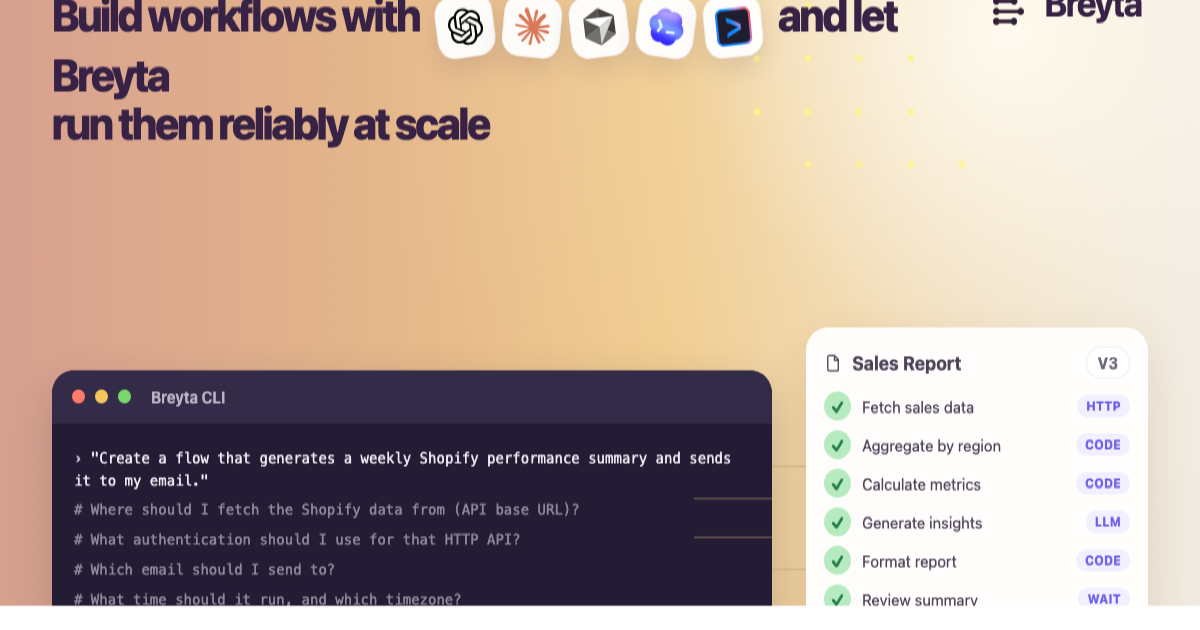
- What it is: A workflow and agent orchestration platform for coding agents. It runs reliable workflows, agent workflows, and autonomous jobs with deterministic execution, clear run history, versioned flow definitions, approvals, waits, a resource model for large outputs, and an agent-first CLI.
- Why developers pick it: Agent-in-the-loop and human-in-the-loop are first-class. Strong draft vs live release control. Long-running remote-agent pattern over SSH with callbacks. Orchestrates local agents too.
- Example fit
- Kick off a coding agent on a VM over SSH, wait for a callback, review the PR payload, approve, and promote a fix live.
- Generate social drafts on a VM, persist memory, request approval, and publish approved posts.
- Notes: Bring the coding agent you already use. Use Breyta as the workflow layer around it.
- Trigger.dev
- What it is: A TypeScript-native durable workflow tool.
- Why developers pick it: Inline TS code, event-driven jobs, and durable execution. Good for teams living in Node and modern frontend stacks.
- Example fit
- Process webhook events, run email or billing steps, and fan out work with retries in a TS codebase.
- Source mention: Trigger.dev as a TS-native durable option appears in the Digital Applied 2026 comparison.
- Inngest
- What it is: An event-driven durable workflow platform.
- Why developers pick it: Strong event model and background job patterns. Works well for microservices and fan-out processing.
- Example fit
- On user signup, fan out enrichment calls, create records, and notify systems with durable checkpoints.
- Source mention: Inngest is profiled as event-driven and durable in the Digital Applied piece.
- Temporal
- What it is: A durable workflow engine used for complex, long-lived processes.
- Why developers pick it: Proven primitives for retries, compensation, and strong consistency. Suits high-stakes backends.
- Example fit
- Payment lifecycles, user provisioning, or multi-day order fulfillment with strict operational guarantees.
- Source mention: Temporal is included in the Digital Applied 2026 lineup.
- AWS Step Functions
- What it is: AWS-native orchestration for Lambda, ECS, and more.
- Why developers pick it: Tight AWS integration, visual states, and managed reliability. Best when your runtime is already all AWS.
- Example fit
- Orchestrate a serverless pipeline that validates input, calls services, branches on results, and writes to DynamoDB.
- Source mention: Listed among the 2026 options by Digital Applied.
- Pipedream
- What it is: A developer-friendly automation platform with code steps.
- Why developers pick it: Fast to wire APIs and write Node code in the flow. Good for glue work and pragmatic integrations.
- Example fit
- Transform a third-party webhook, enrich via HTTP calls, and post into Slack and a custom API.
- n8n
- What it is: A self-hosted open-source automation platform with a visual builder.
- Why developers pick it: Open source, runs anywhere, and extendable with code. Good when you want control of hosting.
- Example fit
- Internal integrations with on-prem systems and custom nodes for private APIs.
- Source mention: n8n is called a self-host OSS leader in the Digital Applied article.
- Zapier AI and Make
- What they are: Visual builders with growing AI features.
- Why developers pick them: Fast non-critical automations and team-friendly visuals. Good for quick wins and lightweight flows.
- Example fit
- Move CRM updates to a sheet, notify a channel, and enrich text with an AI step.
- Apache Airflow
- What it is: An open-source workflow orchestration platform in Python for DAG-based data pipelines.
- Why developers pick it: Python-defined DAGs, a big ecosystem, and batch ETL patterns.
- Example fit
- Nightly extract, transform, and load with task retries and monitoring.
- Reference: See this description of Airflow as an open-source platform to author, schedule, and monitor data pipelines in Greybeam’s 2026 guide on top data orchestration tools.
Decision criteria, mapped to common needs
- Need code-first with durable guarantees
- Pick Temporal, Trigger.dev, or Inngest
- All-in on AWS with serverless operations
- Pick AWS Step Functions
- Self-host with visual builder and OSS
- Pick n8n
- Fast API-to-API glue with code escapes
- Pick Pipedream
- Data engineering teams on Python DAGs
- Pick Apache Airflow
- Agent workflows, long waits, SSH to VMs, and approvals
- Pick Breyta
How Breyta fits developers
- What Breyta is
- A workflow and agent orchestration platform for coding agents. It helps teams build, run, and publish reliable workflows, agent workflows, and autonomous jobs.
- Core model
- Flows are versioned EDN definitions with triggers, steps, approvals, waits, resource refs, run history, and explicit concurrency policy.
- Strong draft vs live split. You iterate in draft, then promote to a stable live target.
- Long-running agents
- Kick off remote work on a VM over SSH, pause with a wait step, then resume on callback. This avoids keeping a fragile long-lived SSH session open.
- Local-agent pattern is supported too.
- Human-in-the-loop
- Approvals, waits, callbacks, and notifications are first-class. You can pause for review and continue later.
- Resources and large outputs
- Persist large artifacts and pass compact res:// references between steps. Inspect with CLI resource commands.
- CLI and agent-first operation
- The CLI returns stable JSON. It is designed for coding agents to parse. You can script flows, runs, and resources.
- Real examples Breyta supports
- Local coding-agent execution
- VM-backed agents over SSH with callback waits
- Autonomous code improvement flows that open review-ready PRs
- Approval-heavy workflows that validate and then apply changes
- Content operators that draft, persist memory, and publish after approval
- Packaging and reuse
- Build internal flows. Publish templates or mini-apps for reuse and distribution.
- Security and credentials
- Connect accounts once. Secrets are stored securely. Flows reference connections, not raw credentials.
- Operations
- Breyta handles execution, state, retries, and recovery for the orchestration layer. You still bring external systems, APIs, or VMs when needed.
- Pricing facts that are safe to state
- Unlimited users, workflows, steps per flow, and concurrent executions
- Billing based on monthly step executions
- Run history retention varies by plan
- Triggers, waits, and approval steps do not count as billable step executions
FAQ
Workflow orchestration vs data orchestration
- Workflow orchestration coordinates application and ops tasks across APIs, services, agents, humans, and infrastructure.
- Data orchestration focuses on data pipelines, DAGs, and batch or streaming jobs.
- Tools like Apache Airflow skew to data pipelines. Tools like Temporal, Inngest, and Breyta cover broader application and agent workflows.
Code-first vs no-code
- Code-first fits teams that want typed SDKs, version control, and testable logic.
- No-code fits quick wins, citizen automation, and simple integrations.
- Many teams run both. Use no-code for lightweight tasks. Use code-first for core systems and anything that must be durable and reviewable.