Reliable, Scalable Workflows: Patterns for Resilience and Growth
By Chris Moen • Published 2026-02-06
Reliable, scalable workflows complete correctly under faults and grow with demand without manual work or runaway cost. Use clear patterns for retries, idempotency, durable state, backpressure, autoscaling, and versioned releases.
Quick answer: what makes workflows reliable and scalable?
Reliable workflows keep running through transient faults and recover without data loss. Scalable workflows handle rising and falling load efficiently. The fastest wins come from disciplined retries, idempotency, durable state, and autoscaling tied to real workload signals.
Quick wins:
- Use exponential backoff + jitter, with max attempts and timeouts
- Make every step idempotent with operation-scoped keys
- Move progress into durable state between steps
- Apply rate limits and backpressure; use a dead-letter queue (DLQ)
- Autoscale on queue depth, message age, or user-facing latency
For agent-specific orchestration patterns, see other posts on the Breyta blog. This article covers the broader reliability and scalability patterns that apply to any workflow system.
What breaks reliability and scale in workflows?
Brittle tasks, hidden state, and unbounded concurrency are the usual culprits. Weak error handling, missing backpressure, and absent autoscaling often turn small hiccups into outages or high cost.
- Non-idempotent steps and duplicate deliveries
- Long-running tasks without heartbeats or checkpoints
- Shared mutable state and missing transactional boundaries
- Missing timeouts, aggressive retries, and lack of circuit breakers
- No DLQ or replay plan for poison messages
- Low signal-to-noise in observability and alerts
- Hard-coded limits with no scale-in rules
Design for failure: make workflows fail safe
Assume any dependency can be slow, return partial results, or time out. Contain blast radius and enable fast, safe recovery.
- Apply per-call timeouts; avoid relying only on global timeouts
- Use exponential backoff + jitter; cap attempts and total retry duration
- Introduce circuit breakers to shed load from flaky dependencies
- Persist progress in durable state after each unit of work
- Prefer at-least-once delivery with idempotency over fragile exactly-once
Make long-running workflows resilient
Break work into smaller checkpoints. Detect stuck work and support human control.
- Checkpoint after each step and store minimal state needed to resume
- Use heartbeats to detect stuck or slow tasks; abort or reschedule safely
- Support pause, resume, and cancel with clear compensation steps
- Set per-step SLAs; alert on user impact, not just internal errors
Retries, idempotency, and timeouts: concrete rules
- Retries: exponential backoff + jitter; cap attempts and total retry window; classify retryable vs. terminal errors
- Idempotency: generate an idempotency key per logical operation; upsert by key; return prior result on duplicate
- Timeouts: set explicit deadlines per operation; shorten under load to avoid retries piling up
- DLQ: route messages after max attempts; track, replay with guardrails, or quarantine
Manage state, queues, and events
Keep state explicit and durable. Use queues for work distribution and events for decoupling.
- Durable state: use a database or workflow state store; keep payloads small and schemas versioned
- Queues: control concurrency and apply backpressure; isolate workloads with dedicated queues where needed
- Events: publish state changes; include schema/version for safe consumers
- Transactions: use a transactional outbox or two-phase write to avoid lost or duplicated events
Scale out and scale in cost‑effectively
Tie concurrency to signals that reflect user impact, and scale down gracefully.
- Autoscale on queue depth, message age, or service latency
- Enforce rate limits and concurrency caps per dependency
- Use cooldowns and scale-in policies to avoid thrashing
- Batch tiny tasks where it reduces overhead without hurting latency
- Favor stateless workers; hold only pointers, keep state in durable stores
Version and evolve workflows without breaking runs
Expect change. Keep running instances stable and new runs safe.
- Assign semantic versions to workflow definitions
- Pin in-flight runs to their original version
- Support parallel read of old/new payload schemas; provide adapters
- Migrate with replay or stepwise rollout; always keep a rollback plan
Metrics and alerts that matter
Measure what reflects user experience and saturation, not just machine health.
- End-to-end and per-step latency; success/error rates by step
- Queue depth, oldest message age, and DLQ rate
- Effective concurrency, CPU/memory/I/O utilization
- SLO attainment and backlog burn-down
Alert on: sustained SLO violations, error spikes above baseline, queue age thresholds, DLQ growth, and missing heartbeats.
Test reliability and scale
Prove it under load and failure, not just in happy paths.
- Unit tests for step logic and idempotency behaviors
- Integration tests with real queues, timers, and state stores
- Soak tests at expected peak; stress tests above peak
- Chaos tests for timeouts, partial failures, and slow dependencies
- Replay tests to validate version upgrades and migrations
Security and compliance for automated workflows
Protect data, minimize access, and keep audit trails.
- Encrypt in transit and at rest; rotate secrets via a vault
- Apply least privilege to workers, queues, and stores
- Redact sensitive data in logs and traces
- Validate inputs and enforce schemas at boundaries
- Record change history and run history for audits
Workflow engine vs. custom code
Use a workflow engine when you need durability, visibility, and human-in-the-loop steps. Simple, short, stateless jobs can stay as custom code.
- Engines help with: durable state and replay, scheduled retries, timers and signals, human approvals/waits, and clear run history
- Custom code fits: single-service ownership, low change frequency, and short-lived tasks without coordination
Common failure modes and quick fixes
- Duplicate processing — Fix: idempotency keys and upserts
- Stuck runs — Fix: heartbeats, timeouts, and safe retries
- Runaway retries — Fix: backoff with jitter and max attempts
- Queue overload — Fix: worker autoscaling and rate limits
- Version mismatches — Fix: schema versioning and dual-read adapters
How Breyta fits
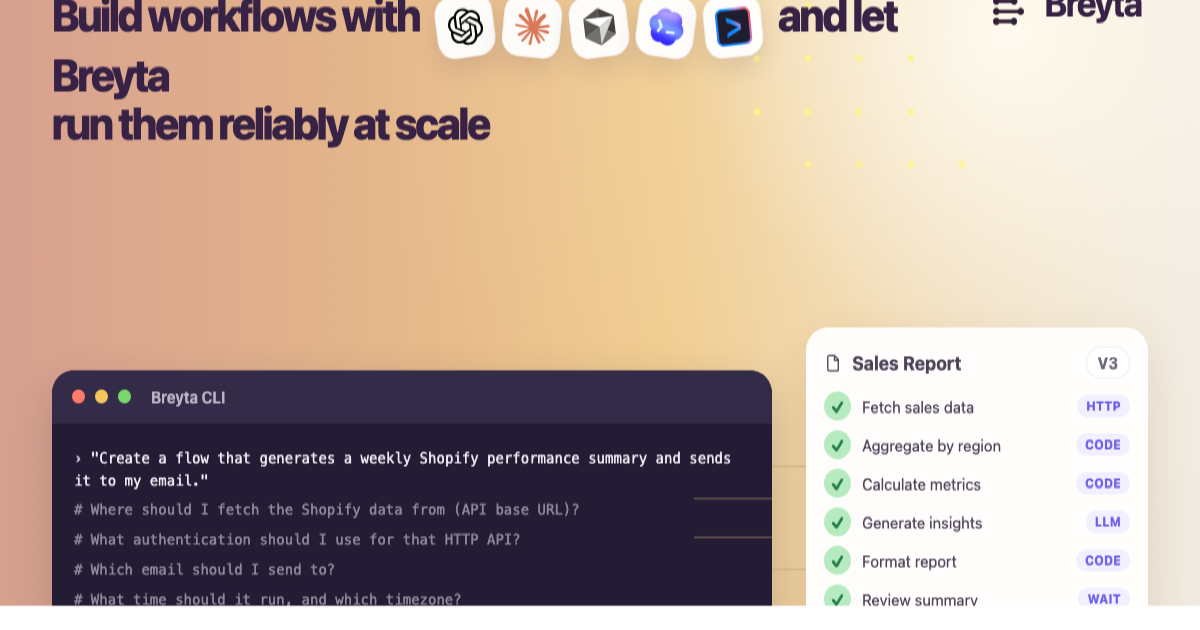
Breyta is a workflow and agent orchestration platform for coding agents. It is built for multi-step automations, long-running jobs, approval-heavy flows, and agent orchestration. Breyta provides deterministic runtime behavior, explicit approvals and waits, versioned releases, resource refs, and clear run history, with an agent-first CLI. You can orchestrate local agents and VM-backed agents over SSH. In practice, these capabilities map directly to the reliability and scalability patterns above: durable state and deterministic execution, human approvals where needed, versioned definitions for safe evolution, and auditable run history for debugging and compliance. For more on this category, see reliable agent workflows.
FAQ
What is the simplest way to add reliability to an existing workflow?
Add retries with backoff and jitter, idempotency keys, and a DLQ. Put per-call timeouts in place and start tracking latency, error rate, and queue age.
How do I prevent duplicate work when messages are retried?
Use an idempotency key per logical operation. Upsert results keyed by that value and return the stored result on duplicate attempts.
How should I handle very long steps?
Split them into smaller steps with checkpoints. Add heartbeats to detect stalls and support pause, resume, and cancel.
How do I pick autoscaling triggers?
Autoscale on signals that reflect user impact, such as queue age, depth, or service latency. Add scale-in policies and cooldowns to avoid thrashing.
Do I need a workflow engine?
Use one when you need durable state, timers, retries, approvals/waits, and clear run history. Keep simple, stateless tasks in custom code. When you need workflow orchestration around coding agents, consider Breyta.