Breyta vs. n8n, Make, Pipedream, Zapier: Choosing the Right Workflow Automation for Agents and Complex Workflows
By Chris Moen • Published 2026-04-03
Compare workflow automation tools like n8n, Make, Pipedream, Zapier, and Breyta to find the best fit for your agent-based, long-running, or complex production workflows.
Quick answer
If you need classic app automations, tools like Make, Pipedream, and Zapier cover many use cases. If you need reliable multi-step workflows with agents, waits, approvals, and long-running or VM-backed work, use Breyta. It is a workflow and agent orchestration platform for coding agents.
Disclosure: Breyta is our product
What does “n8n alternative” mean in practice?
Teams ask for an n8n alternative when:
- Jobs run longer than a single API call.
- A human must approve before a change goes live.
- A coding agent or VM does heavy work outside the workflow host.
- You need clear run history, versioned releases, and safe rollout.
In short, you want structure around complex workflows. You want deterministic runs, not a pile of ad hoc scripts.
Decision criteria that matter for production
Look for these traits before you switch.
- Reliability and history
- Deterministic execution
- Step-by-step outputs
- Inspectable runs over time
- Release control
- Draft vs live split
- Versioned flow definitions
- Approvals and safe rollout
- Long-running and external work
- Waits and callbacks
- SSH to VMs
- Local or remote agent runs
- Agent-first operation
- CLI with stable JSON output
- Flows, runs, and resources are scriptable
- A clean boundary between worker and workflow
- State and artifacts
- Resource refs for large outputs
- Persisted artifacts with inspectable history
- Secrets and connections
- Connect accounts once
- Reference connections in flows
- Keep credentials out of logic
- Reuse and distribution
- Templates and published apps
- Installable live targets
- Pricing shape
- Understand what is billable
- Know retention expectations
Comparison at a glance
This table focuses on fit and buyer scenarios rather than feature checklists.
| Tool | Best fit | Example use case | Notes for production scale |
|---|---|---|---|
| Breyta | Agent workflows and complex automations that need waits, approvals, versioned releases, and long-running or VM-backed work | Kick off a coding agent on a VM over SSH, wait for a callback, then continue to approval and release | Deterministic runs, draft vs live, approvals, waits, resource refs, and an agent-first CLI. Built for coding-agent orchestration. |
| n8n | Node-based automations with custom logic where teams want flexibility and self-directed building | Multi-step API integrations with custom transforms | Consider how you will handle long waits, human checkpoints, and release control. |
| Make | Visual app-to-app automations and routing | Move records between tools on a schedule or event | Check how you will manage long-running jobs and approval gates. |
| Pipedream | Event-driven integrations and quick API wiring | Webhook-triggered data processing with HTTP calls | Plan for run history, waits, and external worker callbacks. |
| Zapier | Common app automations and fast setup | Form-to-CRM sync and notifications | Confirm guardrails for complex, long, or approval-heavy flows. |
How Breyta fits this use case
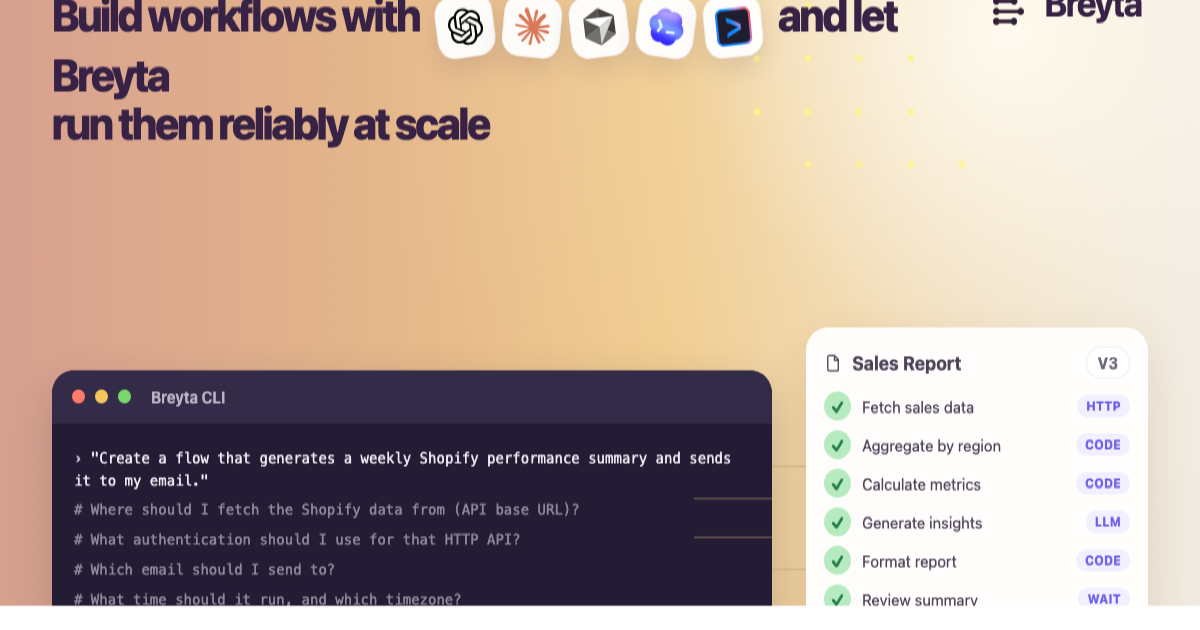
Breyta is a workflow and agent orchestration platform for coding agents. It helps teams build, run, and publish reliable workflows, agents, and autonomous jobs. It emphasizes deterministic execution, clear run history, and versioned releases.
What that looks like day to day:
- Flows are versioned definitions with triggers, steps, and an explicit concurrency policy.
- You work in draft. You run and inspect. You promote to live when approved.
- Approvals and waits are first class. Flows can pause for a human or wait for an external callback.
- Long-running jobs follow a documented remote-agent pattern:
- Kick off remote work over SSH.
- Pause with a wait step.
- Resume when the remote worker posts back.
- The CLI is agent-first. Commands return stable JSON. Your coding agent can parse and operate flows.
- Large outputs are stored as resources. Steps pass compact res:// refs. Artifacts stay inspectable.
Documented step families include http, llm, search, db, wait, function, notify, kv, sleep, and ssh. Triggers include manual, schedule, and webhook or event.
Real examples the product supports:
- Run a local Codex agent with waits and resume when done.
- Answer support queries on a VM over SSH and renew Gmail watch subscriptions.
- Kick off a detached coding worker on a VM, wait for callback, and return a review-ready PR payload.
- Get human approval for a validated draft fix, then release and promote it live.
- Generate social drafts on a dedicated VM, persist memory, request approval, then dispatch approved posts.
- Orchestrate research across multiple sources and export results.
Why this matters for production workflows
- You need runs you can trust
- Deterministic behavior makes failures debuggable.
- Step outputs and history make audits simple.
- You need controlled change
- Draft vs live keeps iteration safe.
- Releases are versioned and immutable.
- You need to span time and systems
- Waits and callbacks handle long jobs and external workers.
- SSH supports VM-backed agents without fragile long-lived steps.
- You need agents in the loop
- The CLI is built for coding agents like Codex, Claude Code, Cursor, and Gemini CLI.
- The workflow layer stays separate from the worker or model.
Concrete buyer scenarios
- Choose Breyta when
- A coding agent does the heavy lifting.
- You need SSH to remote VMs and waits for callbacks.
- A human must approve before promotion to live.
- You want resource refs for large artifacts.
- Consider n8n, Make, Pipedream, or Zapier when
- You mainly need app-to-app automations.
- Jobs are short and straightforward.
- Visual wiring and quick setup are top priorities.
Pricing shape to know about Breyta
These are safe facts from the product:
- Unlimited users
- Unlimited workflows
- Unlimited steps per flow
- Unlimited concurrent executions
- Billing is based on monthly step executions
- Run history retention varies by plan
- Triggers, waits, and approval steps do not count as billable step executions
FAQ
Is Breyta a coding model or an agent?
No. Breyta is not a coding model and does not replace your coding agent. It is the workflow layer around it.
Can I run non-AI automations on Breyta?
Yes. Breyta is a general workflow runtime with primitives for backend work, agents, and approvals. It is not only about LLM steps.
Do I need to manage infrastructure?
No for core workflow execution. Breyta handles execution, state, retries, and recovery. You can still bring external systems, APIs, VMs, and SSH targets when your flow needs them.
How does Breyta handle large outputs?
Persist large artifacts and pass res:// refs between steps. Use the CLI to inspect resources. This keeps workflow state compact and runs inspectable.
Bottom line
If your next stage needs agents, long-running jobs, VM-backed steps, approvals, and real release control, Breyta fits. If you need fast, common app automations, tools like Make, Pipedream, and Zapier remain strong choices. Pick based on the depth and reliability your production workflows require.