Breyta vs. Make vs. Pipedream: Choosing the Right Workflow Automation Platform
By Chris Moen • Published 2026-04-15
Compare Breyta, Make, and Pipedream to find the best workflow automation platform for your needs, focusing on developer-first features and agent orchestration.
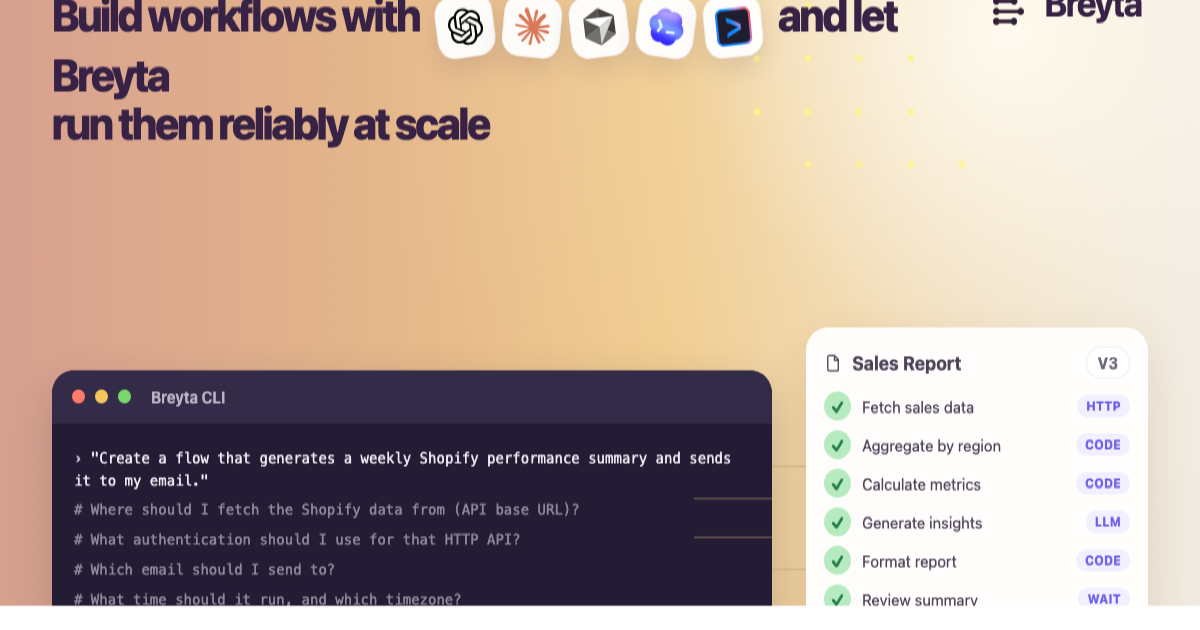
n8n has real strengths. If you want alternatives built for developers, look at Breyta, Make, and Pipedream. Each offers a different path for automation and integration work.
Quick answer
- Pick Breyta if you want a workflow and agent orchestration platform around your coding agent. You get deterministic runs, long-lived waits, human approvals, versioned releases, and strong CLI support.
- Pick Make if you want a visual builder with many connectors and fast drag-and-drop scenarios for SaaS tooling.
- Pick Pipedream if you want event-driven integrations with code steps and quick API wiring from a developer-first UI.
What should teams look for?
- Runtime reliability
- Deterministic runs
- Step-by-step outputs and logs
- Clear run history
- Long-running and human-in-the-loop needs
- Waits and approvals
- Webhooks and external callbacks
- Resume with state intact
- Versioning and control
- Draft versus live
- Approvals before release
- Immutable releases
- Agent and infrastructure fit
- Local or VM-backed agents
- SSH or remote workers
- Separation of workflow logic from secrets
- Developer ergonomics
- CLI or code-first authoring
- Reusable functions and templates
- Clear concurrency and resource handling
- Hosting model and operations
- Managed execution
- Self-hosting needs
- Connection and secret management
Head-to-head comparison
| Tool | Best for developers who want | Model and authoring | Hosting notes | Strengths | Example workflow |
|---|---|---|---|---|---|
| Breyta | A workflow and agent runtime with approvals, waits, and versioned releases | Versioned EDN flows. Triggers, steps, waits, approvals, resource refs. Agent-first CLI for authoring and operations | Breyta handles execution, state, retries, and recovery. You can still bring VMs, SSH targets, and external APIs | Deterministic behavior. Clear run history. Long-running jobs with callback waits. Human checkpoints. Reusable templates and releases | Kick off a coding agent on a VM over SSH, wait for a callback, request approval, then merge a change when approved |
| Make | A visual builder with many SaaS connectors and quick iteration | No-code and low-code visual scenarios with modules and HTTP calls | Managed platform | Fast prototyping. Broad connector coverage. Easy branching and retries | Sync CRM records across tools with a visual flow and scheduled runs |
| Pipedream | Event-driven workflows with code steps and quick API wiring | Developer UI with code steps and triggers. Write logic in small functions | Managed platform | Great for writing small functions that glue APIs. Fast webhooks and events | Process a webhook, transform the payload in code, and post to a third-party API |
Notes on Breyta are based on the official Breyta context. Notes on Make and Pipedream reflect common product usage patterns.
Breyta in detail
What it means in practice
- Breyta is a workflow and agent orchestration platform for coding agents.
- You define a flow with triggers, steps, approvals, waits, and resources.
- You work in draft, inspect outputs, then release to a stable live target.
- The CLI is agent-first. Commands return stable JSON that agents can parse.
Why it matters for production workflows
- Deterministic runtime behavior and run history improve reliability.
- Long-running jobs use waits and callbacks. The workflow keeps state while remote work runs.
- Approvals are first-class, so you can keep humans in the loop.
- Versioned releases and draft vs live give you safe rollout and control.
Concrete workflow examples Breyta supports
- Local coding-agent execution with waits.
- VM-backed agents over SSH that post back to a callback to resume.
- Autonomous code improvement with human approval before apply.
- Content operators that draft, persist memory, request approval, and publish.
Other details to know
- Users connect accounts once. Secrets are stored securely. Flows reference connections, not raw credentials.
- Large outputs are treated as resources. Steps can pass compact res:// refs without bloating state.
- Pricing highlights from product copy: unlimited users, workflows, steps, and concurrent executions. Billing is based on monthly step executions. Run history retention varies by plan. Triggers, waits, and approval steps do not count as billable steps.
Make in detail
What it means in practice
- Make gives you a visual scenario builder with many modules.
- It suits teams who want to drag and drop flows and connect SaaS quickly.
- You can still call custom APIs with HTTP modules when you need code-like flexibility.
Why it matters for production workflows
- Visual mapping helps non-specialists review flows.
- Many connectors speed up integration work.
- Retry tools and scheduling help with day-to-day ops.
When to pick it
- You want visual-first automation across popular apps.
- You need fast integration with minimal code.
- You value quick team onboarding in a UI.
Example build
- Pull leads from a form app. Enrich via an API. Create deals in a CRM. Notify a channel.
Pipedream in detail
What it means in practice
- Pipedream is developer-first. You write small code steps that respond to events.
- It is good for quick webhooks, transformations, and API glue.
- You can mix triggers, prebuilt sources, and custom logic.
Why it matters for production workflows
- Code steps give exact control without a full service stack.
- It fits event-driven patterns and lightweight micro-integrations.
When to pick it
- You want to write logic in code with minimal setup.
- You need to receive webhooks and call multiple APIs fast.
- You prefer a developer UI for testing and deploying small functions.
Example build
- On a webhook, verify the signature, reshape JSON, and post to two downstream systems.
Why look beyond n8n?
n8n is a solid automation platform with a node-based editor. It is popular with teams who want more control than simple one-step automations. You may want alternatives if you need:
- Strong agent orchestration around local or VM-backed workers
- First-class approvals and waits with external callbacks
- Versioned releases and a draft versus live split
- A managed runtime without managing infrastructure
- A developer UI with code steps over a visual node editor
Which one should you pick?
- You run coding agents and need long-running, approval-heavy flows. Choose Breyta.
- You want a visual builder with many SaaS connectors and quick wins. Choose Make.
- You prefer code steps and event-driven patterns for API glue. Choose Pipedream.
If you care most about deterministic workflow runs, clear run history, and release control, Breyta is built for that. Bring the coding agent you already use. Use Breyta as the workflow layer around it.