The Best Workflow Orchestration Tools for 2026
By Chris Moen • Published 2026-04-02
Explore the top workflow orchestration tools for 2026, comparing their strengths for data pipelines, microservices, serverless tasks, and AI agent jobs. Find the best fit for your needs.
Opening answer
The best workflow orchestration tools in 2026 cover data pipelines, microservices, serverless tasks, and agent-driven jobs. Start with your runtime needs, then match to a tool that is strong on reliability, visibility, and rollout. See the shortlist and examples below.
_Disclosure: Breyta is our product._
Quick answer: the shortlist
- Apache Airflow: Open source, DAG-based data pipelines
- Prefect: Python-first orchestration with strong observability
- Dagster: Data-aware orchestration with software-defined assets
- Temporal: Durable execution for long-running service workflows
- Argo Workflows: Kubernetes-native batch and pipelines
- AWS Step Functions: Managed serverless state machines on AWS
- Google Cloud Workflows: Managed orchestration across GCP services
- Azure Data Factory: Data movement and ETL in Azure
- Apache NiFi: Visual dataflow for streaming and batch
- Breyta: Workflow and agent orchestration for coding agents, long-running, approval-heavy jobs
_Note: CI/CD tools are different. They build and deploy code. Orchestration runs your business and data workflows. For CI/CD leaders in 2026, see JetBrains’ overview of GitHub Actions, Jenkins, and GitLab CI._
What should teams look for?
- Runtime model and durability
- Handles long-running work, waits, retries, idempotency
- Clear concurrency control and determinism
- Human-in-the-loop
- Native approvals and waits when business risk is high
- Agent and VM control
- Orchestrates local agents, SSH to VMs, callbacks
- First-class observability
- Step outputs, run history, artifacts, and logs
- Versioning and rollout
- Draft vs live, pinned runs, safe releases
- Secrets and connections
- Separate credentials from workflow code
- Triggers and eventing
- Manual, schedule, webhook, event streams
- Developer ergonomics
- Code-first authoring, strong CLI, templates, testability
- Hosting model
- Self-hosted, cloud-managed, or hybrid
- Cost clarity
- Understand how executions, steps, and retention are billed
Comparison table
| Tool | Best for | Why developers pick it | Example workflow |
|---|---|---|---|
| Apache Airflow | Data pipelines | Mature DAGs and ecosystem | Nightly ETL that loads, transforms, and backfills a warehouse |
| Prefect | Python data flows | Pythonic API, observability, retries | Real-time ingestion with task-level retries and alerting |
| Dagster | Data-aware pipelines | Software-defined assets, testing | Asset-based pipeline with backfills and lineage checks |
| Temporal | Long-running services | Durable, stateful execution | Order workflow with saga pattern across microservices |
| Argo Workflows | K8s batch | Kubernetes-native steps and artifacts | Parallel model training jobs on a GPU node pool |
| AWS Step Functions | Serverless on AWS | Managed state machines | Glue Lambda, SNS, SQS, and Glue jobs with error handling |
| Google Cloud Workflows | GCP orchestration | Integrates GCP services fast | Orchestrate Cloud Run, Pub/Sub, and BigQuery loads |
| Azure Data Factory | Azure ETL | Data movement at scale | Copy from S3 to ADLS, then trigger Synapse transforms |
| Apache NiFi | Streaming/dataflow | Visual flows and routing | Route IoT events, filter, and push to Kafka and S3 |
| Breyta | Agent-driven, long-running, approvals | Deterministic agent and workflow runtime with approvals, waits, SSH, and versioned releases | Kick off a coding agent on a VM, wait for callback, request approval, then publish the result |
Tool-by-tool notes and buyer scenarios
Apache Airflow
Airflow is an open-source workflow orchestration tool used by many data teams. It works with DAGs and a large ecosystem of operators. See this comparison of Airflow, Temporal, and Breyta overview of workflow tools noting how Airflow fits data use cases.
- Buyer fit: Teams that want code-first DAGs and self-managed control.
- Example: Nightly ETL across multiple sources with backfills and SLAs.
Prefect
Prefect is Python-first with a focus on observability and resilience. It fits mixed on-prem and cloud runs.
- Buyer fit: Python shops that want quick wins and clean retries.
- Example: Ingest from APIs, fan out transforms, notify on failures.
Dagster
Dagster treats data as assets. That helps with lineage, testing, and redeploys.
- Buyer fit: Analytics teams that want asset-driven orchestration.
- Example: Lakehouse assets with partitioned backfills and tests.
Temporal
Temporal gives durable, stateful workflows for services. It is good for long-running and distributed work.
- Buyer fit: Backend teams that need sagas, timeouts, and strong guarantees.
- Example: Multi-step order processing with compensation and human review.
Argo Workflows
Argo is Kubernetes-native. It is strong for containerized batch and parallel pipelines.
- Buyer fit: Teams standardizing on K8s operators and CRDs.
- Example: Large-scale map-reduce job with artifact passing.
AWS Step Functions
Step Functions orchestrate AWS services with managed state machines. It fits serverless and event-driven patterns.
- Buyer fit: AWS-first teams that want low-ops orchestration.
- Example: Lambda-based image pipeline with retries and timeouts.
Google Cloud Workflows
Cloud Workflows connect GCP services with low overhead. It is a fast fit for GCP shops.
- Buyer fit: GCP-first teams that want native service orchestration.
- Example: Trigger Cloud Run, call external APIs, load into BigQuery.
Azure Data Factory
Azure Data Factory focuses on data movement and ETL. It scales well for enterprise data estates.
- Buyer fit: Azure data teams that need managed connectors and mapping.
- Example: Copy from on-prem SQL to ADLS, then orchestrate Synapse.
Apache NiFi
NiFi is a visual dataflow tool. It is strong for streaming and routing with back pressure and provenance.
- Buyer fit: Teams that want drag-and-drop routing and transformations.
- Example: Filter IoT telemetry and route to Kafka and an alerting system.
Breyta
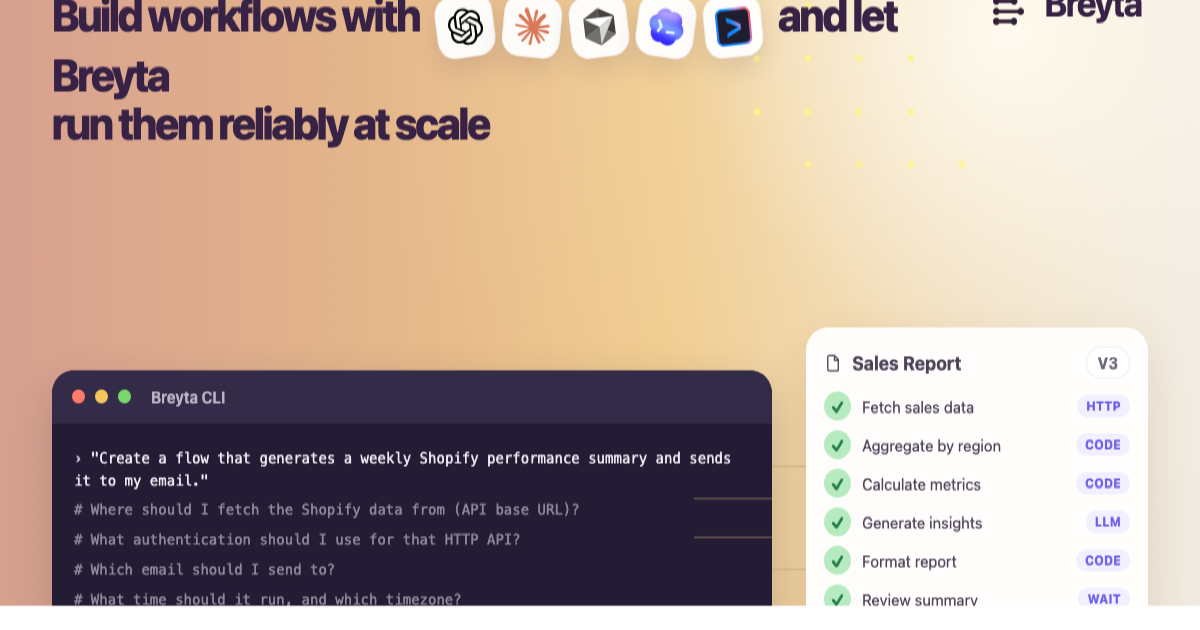
Breyta is a workflow and agent orchestration platform for coding agents. It helps teams build, run, and publish reliable workflows, agents, and autonomous jobs with deterministic execution, clear run history, versioned flow definitions, approvals, waits, reusable templates, and an agent-first CLI.
- Where it fits
- Agent-in-the-loop and autonomous agent runs
- Long-running or VM-backed work over SSH
- Approval-heavy changes that must pause and resume
- Work that needs draft vs live releases and pinned runs
- What it does
- Flows are versioned definitions with triggers, steps, approvals, waits, resource refs, and explicit concurrency
- Triggers include manual, schedule, and webhook/event
- Step families include http, llm, search, db, wait, function, notify, kv, sleep, ssh
- Long-running pattern: start remote work over SSH, wait for callback with a wait step, then resume with structured output
- Large outputs become persisted resources with compact
res://refs - CLI is agent-first, returns stable JSON, and lets agents operate flows, runs, and resources
- Security and ops
- Connect accounts once, store secrets securely, and reference connections from flows
- Breyta runs the orchestration layer. You can still bring your own APIs, VMs, or SSH targets
- Pricing facts
- Unlimited users, unlimited workflows, unlimited steps per flow, and unlimited concurrent executions
- Billing is based on monthly step executions
- Run history retention varies by plan
- Triggers, waits, and approval steps do not count as billable step executions
- Example workflows
- Kick off a coding agent on a VM, wait for a callback, get human approval, then publish a PR payload
- Generate content drafts on a dedicated VM, persist memory, request approval, and dispatch approved posts
- Answer support queries on a VM over SSH and maintain external watches
Why this matters for production workflows
- Reliability: Durable runs, retries, and deterministic behavior prevent silent failures.
- Visibility: Clear run history and step outputs speed up root cause analysis.
- Control: Versioned releases and live vs draft split reduce production risk.
- Human checkpoints: Approvals and waits make sensitive updates safer.
- Scale: Concurrency policies, resource refs, and external callbacks support large and long jobs.
When to choose which tool
- Pick Airflow, Prefect, or Dagster for data-centric DAGs and assets.
- Pick Temporal for durable, service-level workflows that span days or weeks.
- Pick Argo when Kubernetes is your main runtime.
- Pick Step Functions, Cloud Workflows, or Data Factory when you live inside one cloud’s ecosystem.
- Pick NiFi when you want visual streaming and routing.
- Pick Breyta when you need agent-first orchestration, long-running or VM-backed runs, approvals, and a clean draft to live release model.
Notes on adjacent tooling
- CI/CD is not orchestration. CI/CD builds and deploys code, while orchestration runs your business and data workflows after deploys. See the 2026 CI/CD landscape for context from JetBrains.
- Low-code builders can help non-developers. If you need hands-on low-code options, see this guide to low-code AI workflow tools from Vellum.
- Regulated teams may need privacy-preserving controls. See this comparison of privacy-preserving AI workflow tools for governance themes like self-hosting and certifications from Kiteworks.
FAQ
What does workflow orchestration mean in practice?
It coordinates multi-step work across systems. It manages state, retries, timing, approvals, and handoffs.
Why does it matter for production?
It gives reliability, traceability, and safe rollout. That cuts outages and speeds change.
Can I use CI/CD and orchestration together?
Yes. CI/CD ships code. Orchestration runs the jobs that code performs after release.
How many tools do I need?
Often one or two. Many teams pair a data orchestrator with a service orchestrator, or a cloud-native tool with a specialized agent-focused runtime like Breyta.